Best Facturas Near Me: Argentina’s Bakery Pastries
Walk into any Argentine bakery in the morning and the counter is covered in small glossy pastries, palm-sized, syrup-glazed, filled with dulce de leche or quince. You do not buy one. You buy a dozen, tied with string, and the names you use come from a bakers’ strike in the 1880s. If you are searching for the best facturas near me, here is what to know.
What Facturas Are
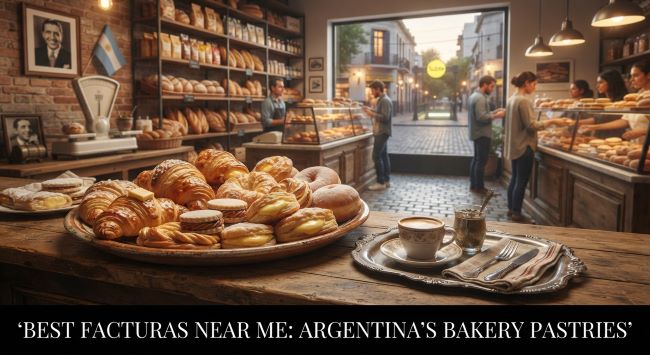
Facturas are the category of sweet pastries sold in Argentine bakeries, made from an enriched, laminated dough and typically glazed with a light sugar syrup.
The best facturas near me will include a range of shapes and fillings rather than a single item. The category covers:
- Medialunas, the crescent-shaped pastries that are by far the most popular.
- Bolas de fraile, round filled doughnuts, usually with dulce de leche or pastry cream.
- Vigilantes, elongated pastries often topped with quince or sweet potato paste.
- Cañoncitos, tubes filled with dulce de leche or crema pastelera.
- Libritos, folded book-shaped pastries.
- Sacramentos, rectangular filled pastries.
- Tortitas negras, flattened rounds topped with dark caramelized sugar.
The unifying features are the enriched dough, the small individual size, and the glossy almíbar glaze that gives them their characteristic shine and stickiness.
The Names Are Political
This is the genuinely interesting part of the best facturas near me story. Many names carry anticlerical meanings, traced to the Argentine bakers’ union in the 1880s, when anarchist bakers during a period of strikes gave their pastries provocative names mocking the church, police, and military.
Bolas de fraile means friar’s balls. Sacramentos references the sacraments. Vigilantes was slang for police. Cañoncitos means little cannons. The names stuck, entered ordinary usage, and are now used without political intent by people ordering breakfast.
The Fillings
Understanding the fillings helps in the best facturas near me search, since they define most varieties:
Dulce de leche dominates, thick and intensely sweet. Crema pastelera appears as a lighter alternative. Membrillo, quince paste, provides a firmer, slightly tart contrast, and batata, sweet potato paste, is used similarly and is distinctly Argentine. Many bakeries sell mixed dozens so you get a spread rather than committing to one.
Where to Find Them
The best facturas near me search runs through:
Argentine bakeries and panaderías, the ideal option, where they are made fresh daily.
Argentine cafés and restaurants, which serve them alongside coffee.
Uruguayan bakeries, since Uruguay shares essentially the same tradition.
Latin American bakeries in areas with Southern Cone communities.
Timing matters. The best facturas near me are baked in the morning and best within hours, though bakeries frequently produce a second batch for the afternoon merienda.
How to Order Like a Local
A practical point that trips up visitors. Facturas are sold by the docena, the dozen, or the media docena, the half dozen. Buying a single pastry is possible but unusual.
The standard approach is asking for a docena and either specifying varieties or letting the bakery make a mixed selection, which is called surtidas. They are packed in a box or paper bag, and traditionally tied with ribbon or string.
Prices are low and facturas are treated as everyday food rather than an indulgence, which is why buying twelve at a time is normal rather than excessive.
How to Judge Quality
Evaluating the best facturas near me comes down to freshness and dough:
| Element | Done right | Warning sign |
|---|---|---|
| Freshness | Baked that morning | Dry, stale, or hard |
| Dough | Light, layered, tender | Dense, heavy, or bready |
| Glaze | Glossy, lightly sticky | Absent or thickly sugary |
| Filling | Generous, good quality | Sparse or artificial-tasting |
| Variety | Broad selection available | Only one or two types |
Freshness is decisive. Facturas stale quickly, and a pastry sitting since yesterday is noticeably dry and heavy. Buying from a bakery with high turnover matters more than almost anything else.
Dough quality separates good bakeries from indifferent ones. Properly made facturas are light with visible layering, while poor ones are dense and bread-like.
Selection breadth is itself an indicator. A bakery displaying eight or ten varieties is taking the category seriously.
When They Are Eaten
Facturas are morning and afternoon food rather than dessert. The classic contexts are breakfast with coffee and the merienda, the Argentine afternoon snack around five or six, which is a daily institution. Mate is equally traditional. They are also standard for bringing to someone’s house or an office, which is why the dozen-in-a-box format exists.
Part of the Bread and Pastry Tradition
What makes facturas interesting is how completely they occupy their own category, distinct from French viennoiserie despite the shared technique, shaped by Italian and Spanish immigration into something specifically Argentine. Every country with a bread culture has developed comparable specialties tied to particular regions and hours of the day. A guide like Best Sobrasada with Bread Near Me covers the Balearic tradition of a spreadable cured sausage eaten on bread, and setting it against Argentine facturas shows how bread-based everyday eating develops entirely differently depending on whether a culture takes it sweet or savory.
The bottom line on the best facturas near me search is that these are Argentine bakery pastries made from enriched laminated dough, glazed with syrup, and filled with dulce de leche, pastry cream, quince, or sweet potato paste, sold by the dozen rather than individually. Their names, including bolas de fraile and vigilantes, come from anticlerical bakers in the 1880s. Find an Argentine or Uruguayan panadería, buy a mixed docena in the morning when they are freshest, judge them on light layered dough rather than dense bready texture, and eat them with coffee or mate.
Key Takeaways
- Facturas are the category of Argentine bakery pastries, made from enriched laminated dough and syrup-glazed.
- Varieties include medialunas, bolas de fraile, vigilantes, cañoncitos, libritos, sacramentos, and tortitas negras.
- Many names are anticlerical, traced to anarchist bakers during 1880s labor organizing in Argentina.
- Bolas de fraile means friar’s balls, vigilantes was slang for police, and cañoncitos means little cannons.
- Common fillings are dulce de leche, pastry cream, quince paste, and sweet potato paste.
- They are sold by the docena or media docena rather than individually, often as a mixed selection called surtidas.
- Find them at Argentine and Uruguayan panaderías, cafés, and Latin bakeries serving Southern Cone communities.
- Freshness is decisive, since facturas stale quickly and are best within hours of baking.
- Good facturas have light, visibly layered dough rather than a dense, bread-like texture.
- They are eaten at breakfast and at the merienda, the Argentine afternoon snack, with coffee or mate.