Best Pastelon Near Me: The Caribbean Plantain Lasagna
Layers of sweet ripe plantain in place of pasta sheets, seasoned ground beef between them, cheese melted over the top. People call it plantain lasagna because the structure is identical, but the sweetness of the plantain against savory picadillo produces something no lasagna does. If you are searching for the best pastelon near me, here is the guide.
What Pastelón Is
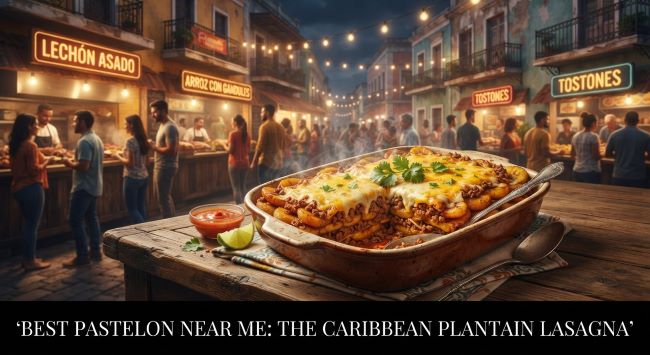
Pastelón is a layered casserole built on ripe plantains, found in Puerto Rican and Dominican cooking. The best pastelon near me consists of:
- Sweet ripe plantains, sliced lengthwise and fried, forming the layers.
- Picadillo, seasoned ground beef cooked with sofrito, tomato, olives, and capers.
- Cheese, layered through and melted over the top.
- Eggs, beaten and poured through to bind the layers.
- Sometimes green beans, a traditional Puerto Rican addition.
The assembly mirrors lasagna exactly: a layer of plantain, a layer of meat, repeated, then baked until set and the cheese browns.
The Plantains Must Be Ripe
This is the most important thing in the best pastelon near me search, and where poor versions fail. Pastelón requires maduros, ripe plantains that are yellow to black rather than green, which are sweet and caramelize when fried. A pastelón made with underripe plantains loses the sweetness the entire dish is built around, and the contrast with the savory beef disappears. That tension is the point.
The Picadillo
The meat layer deserves attention, since it carries the savory side of the equation.
Picadillo is seasoned ground beef, and the Caribbean version typically includes sofrito as the aromatic base, along with tomato sauce, olives, and capers. Raisins appear in some versions, adding another sweet element.
The olives and capers are important. Their brininess cuts through both the sweet plantain and the rich cheese, and a picadillo without them tends to leave the finished dish flat and one-dimensionally sweet.
Puerto Rican and Dominican Versions
Both traditions claim pastelón. The Puerto Rican version frequently includes green beans, uses sofrito heavily, and is bound with egg. The Dominican version, sometimes called pastelón de plátano maduro, is simpler, and Dominican cooking applies the name to casseroles with eggplant or yuca as well. Neither is more correct, and a best pastelon near me search may return either.
Where to Find It
The best pastelon near me search runs through:
Puerto Rican restaurants, where it is a standard comfort food offering.
Dominican restaurants, which serve their own version.
Caribbean and Latin American restaurants with Puerto Rican or Dominican menus.
Latin cafeterias and home-style establishments, which often feature it as a daily special.
Cultural events and festivals, where it is a common offering.
Because pastelón requires assembly and baking, it is more often found at establishments doing genuine home-style cooking than at quick-service places.
How to Judge a Great One
Evaluating the best pastelon near me comes down to a few clear markers:
| Element | Done right | Warning sign |
|---|---|---|
| Plantains | Genuinely ripe, sweet, caramelized | Starchy, underripe, or bland |
| Layers | Distinct and holding together | Collapsed or mushy |
| Picadillo | Well seasoned, olives and capers present | Bland or plain ground beef |
| Cheese | Melted, browned on top | Sparse or rubbery |
| Balance | Sweet and savory in tension | Overwhelmingly sweet |
Plantain ripeness is the decisive test. The plantains should taste sweet and show caramelization from frying. This is the most common failure and the one that most changes the dish.
Structural integrity matters. A good pastelón holds its shape when a portion is lifted, with visible layers. One that collapses into a mash has usually been over-baked or under-set.
Seasoning in the picadillo should be assertive. Bland ground beef against sweet plantain produces an unbalanced result.
How It Is Served
The best pastelon near me is typically presented as a main course:
- Cut into squares, like lasagna.
- With white rice, the standard accompaniment.
- With beans, frequently alongside.
- With a simple salad, to cut the richness.
- Hot, since it needs to be warm for the cheese and structure.
It is filling, and portions tend to be substantial.
Like lasagna, pastelón is often better the following day once the layers have fully set, which is one reason it works well as a made-ahead dish for gatherings.
Why the Combination Works
Caribbean cooking uses sweetness in savory contexts routinely. Sweet plantains accompany savory meals across the region, picadillo often contains raisins, and salty-sweet-briny combinations appear widely. Pastelón concentrates that principle into one dish, where plantain sweetness is structural rather than decorative, counterweighting the salt of the cheese and the brine of the olives. Anyone who enjoys sweet plantains alongside a savory plate already understands the logic.
Variations
Some versions use chicken instead of beef, and vegetarian ones replace the picadillo with vegetables or lentils. The sweet plantain version remains the most common and the one most people mean.
Part of the Caribbean Sweet-Savory Tradition
What makes pastelón worth seeking out is how confidently it commits to sweet and savory together, a combination that many cuisines handle timidly and Caribbean cooking treats as entirely normal. Spanish cooking, which shaped much of the region’s food, employs similar tensions in its own way. A dish like Best Bacalao Vizcaina Near Me shows the Basque approach, where slowly cooked onions and dried sweet peppers build a sauce that is subtly sweet against salt cod, and both illustrate how sweetness used deliberately in a savory dish produces depth rather than confusion.
The bottom line on the best pastelon near me search is that this Puerto Rican and Dominican casserole layers fried sweet ripe plantains with seasoned picadillo and cheese, baked like a lasagna, and it depends entirely on the plantains being genuinely ripe and sweet. Look for Puerto Rican and Dominican restaurants and home-style Latin cafeterias, judge it on caramelized sweet plantain, distinct layers that hold together, and a well-seasoned picadillo containing olives and capers, and eat it hot with rice and beans.
Key Takeaways
- Pastelón is a layered casserole of sweet plantains and seasoned meat, often called plantain lasagna.
- It is found in both Puerto Rican and Dominican cooking, with each tradition having its own version.
- It requires ripe plantains, or maduros, which are sweet and caramelize when fried.
- Using underripe green plantains removes the sweetness the entire dish is built around.
- The meat layer is picadillo, seasoned ground beef with sofrito, tomato, olives, and capers.
- Olives and capers provide brininess that prevents the dish from becoming one-dimensionally sweet.
- Puerto Rican versions often include green beans and are bound with beaten egg.
- Dominican cooking also applies the pastelón name to casseroles built on eggplant or yuca.
- Judge quality by genuinely sweet caramelized plantains, distinct layers, and assertively seasoned picadillo.
- Serve hot with white rice and beans, and note it often improves the following day once fully set.