Best Crema Catalana Near Me: Catalonia’s Classic Custard
Order this in Barcelona and you will get something that looks, at a glance, exactly like crème brûlée: a shallow dish of pale custard under a sheet of cracked caramel. Taste it, and the differences arrive immediately. It is lighter, brighter, and carries citrus and cinnamon rather than vanilla. The two desserts are genuinely distinct, and Catalans will tell you theirs came first. If you are searching for the best crema catalana near me, here is what separates it from its more famous French relative.
What Is Crema Catalana?
Crema catalana is a traditional Catalan dessert consisting of a custard base topped with a hard layer of caramelized sugar. The best crema catalana near me is defined by:
- A milk-based custard, rather than cream, making it noticeably lighter.
- Egg yolks, providing richness and structure.
- Cornstarch, used to thicken the custard on the stovetop.
- Citrus zest, typically lemon and sometimes orange, infused into the milk.
- Cinnamon, commonly a stick infused during cooking.
- A caramelized sugar crust, cracked with the spoon.
The full traditional name is crema de Sant Josep, reflecting its association with Saint Joseph’s Day on March 19, which is Father’s Day in Catalonia and the occasion the dessert is most closely tied to.
How It Differs From Crème Brûlée
This is the central question in almost every best crema catalana near me search, and the differences are real rather than cosmetic:
| Aspect | Crema catalana | Crème brûlée |
|---|---|---|
| Dairy | Milk | Heavy cream |
| Thickener | Cornstarch | Eggs alone |
| Cooking method | Stovetop | Baked in a water bath |
| Served | Chilled | Often slightly warm |
| Flavoring | Citrus zest and cinnamon | Vanilla |
| Texture | Lighter, softer | Denser, richer |
The practical upshot is that crema catalana is a considerably lighter dessert. Using milk instead of cream and cornstarch instead of relying purely on egg coagulation produces a softer, less dense custard.
The cooking method matters too. Crème brûlée is baked slowly in a bain-marie, while crema catalana is cooked on the stovetop like a pastry cream, then poured into dishes and chilled.
And the flavor profile is genuinely different. Citrus and cinnamon give crema catalana a brightness and warmth that vanilla-scented crème brûlée does not have.
Where to Find It
The best crema catalana near me search runs through:
Catalan and Spanish restaurants, the most reliable option, where it is a standard dessert.
Tapas bars with a dessert menu.
Mediterranean restaurants with a genuine Spanish focus.
Spanish bakeries and pastry shops, which sometimes sell it prepared.
Around Saint Joseph’s Day in March, availability often improves at Spanish establishments marking the occasion.
How to Judge Quality
Evaluating the best crema catalana near me comes down to the custard and the crust working together:
The caramel top. It should be a genuine hard sheet that cracks audibly under a spoon, thin rather than thick, and evenly caramelized without burnt patches. A soft, syrupy, or absent top means it was not properly torched or was made too far in advance and has dissolved.
The custard texture. Smooth and silky throughout, with no graininess from scrambled egg and no rubbery firmness from too much starch. It should hold its shape but yield easily.
The flavor. Citrus should be clearly detectable, and cinnamon present as warmth rather than dominance. A version tasting only of sweet egg custard has skipped the infusion that defines the dish.
The temperature contrast. The custard cold beneath the crust is part of the experience, and it should be properly chilled.
That last point is a common failing. Crema catalana is meant to be served cold, and a room-temperature version loses the contrast between cool custard and freshly hardened caramel.
The Traditional Preparation
Part of appreciating the best crema catalana near me is knowing how it is traditionally finished. In Catalonia, the sugar top is classically caramelized with a cremador, a round iron disc heated until glowing and pressed onto the sugar.
This produces a very rapid caramelization that hardens the sugar without warming the custard underneath, preserving the cold-custard contrast. Modern kitchens generally use a blowtorch, which achieves a similar result.
The distinction matters because it explains why the top should be thin and the custard should stay cold. Any method that heats the custard through has departed from the intended result.
How to Enjoy It
The best crema catalana near me is served simply:
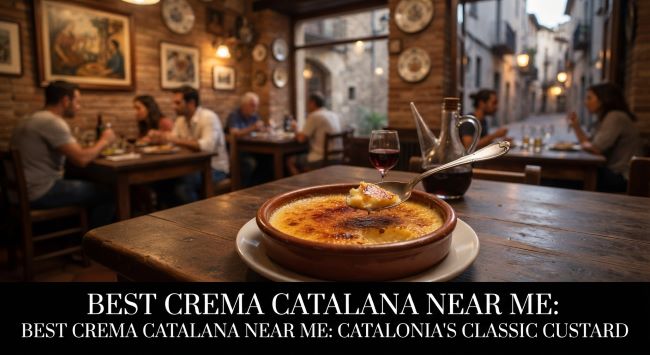
- In a shallow earthenware dish, traditionally, which helps with the wide caramel surface.
- Caramelized just before serving, so the crust is at its crispest.
- With a spoon to crack the top, getting custard and caramel in each bite.
- As a dessert rounding off a Spanish or Catalan meal.
- With a sweet wine such as a moscatel, if you want a pairing.
Eat it reasonably promptly once served, since the caramel begins softening against the custard within minutes.
Part of a Broader Tradition
What makes crema catalana interesting is how it sits within the wider world of Spanish and Latin cooking, where regional identity attaches strongly to particular dishes and each region defends its own version. Exploring these regional specialties is genuinely rewarding for anyone who enjoys this cuisine. A dish like Best Ensalada Waldorf Argentina Near Me shows the same pattern in a different context, where an internationally known dish takes on a distinctly local identity, which is precisely the kind of regional adaptation that makes crema catalana more than simply a Spanish crème brûlée.
The bottom line on the best crema catalana near me search is that this Catalan dessert is genuinely distinct from crème brûlée rather than a copy of it, built on milk rather than cream, thickened with cornstarch, cooked on the stovetop rather than baked, flavored with lemon zest and cinnamon rather than vanilla, and served cold beneath a thin sheet of cracked caramel. Look for it at Catalan and Spanish restaurants, judge it on a crisp thin caramel top, silky custard, clear citrus and cinnamon, and proper chilling, and eat it promptly before the crust softens.
Key Takeaways
- Crema catalana is a traditional Catalan custard dessert topped with a hard caramelized sugar crust.
- It is made with milk rather than cream, making it noticeably lighter than crème brûlée.
- Cornstarch thickens it, and it is cooked on the stovetop rather than baked in a water bath.
- It is flavored with citrus zest, typically lemon, and cinnamon rather than vanilla.
- The traditional name is crema de Sant Josep, tied to Saint Joseph’s Day on March 19.
- The caramel top should be thin and crack audibly, never soft, syrupy, or absent.
- The custard should be silky and smooth, neither grainy from scrambled egg nor rubbery from excess starch.
- It is traditionally caramelized with a hot iron disc called a cremador, now often a blowtorch.
- It should be served cold, since the contrast between chilled custard and fresh caramel is part of the point.
- Eat it promptly after serving, as the caramel begins to soften against the custard within minutes.