Eternal Sunshine of the Spotless Mind: A Complete Guide to the Modern Classic
Some films are admired; a smaller number are genuinely loved, returned to again and again by people who find something new each time. Eternal Sunshine of the Spotless Mind belongs firmly in the second category. Released in 2004, it took a science fiction premise about erasing memories and used it to tell one of the most emotionally honest love stories in modern cinema. Two decades on, it is regularly named among the greatest films of its century, and it remains the movie people recommend when someone asks for something that will genuinely move them. Here is a complete guide to what makes it so special.
What Is Eternal Sunshine of the Spotless Mind?
Eternal Sunshine of the Spotless Mind is a 2004 American romantic science fiction drama directed by Michel Gondry, from a screenplay by Charlie Kaufman based on a story by Kaufman, Gondry, and Pierre Bismuth. It stars Jim Carrey and Kate Winslet as a couple who each undergo a procedure to erase all memories of the other after their relationship falls apart.
The title comes from a line in Alexander Pope’s poem Eloisa to Abelard, referencing the supposed bliss of forgetting, which is precisely the idea the film interrogates. That literary source is a clue to the movie’s ambitions: this is a film about memory, loss, and whether pain is worth the love that caused it, dressed in the clothes of an inventive science fiction premise.
What makes the film remarkable is how it uses that premise. Rather than treating memory erasure as a technological thriller, it turns the process into an emotional journey, largely taking place inside one character’s mind as his memories are being deleted around him. That structural choice is the key to everything the film achieves.
The Story
The plot is best experienced fresh, but the basic shape is worth understanding. Joel Barish is a reserved, melancholy man who discovers that his impulsive, free-spirited former girlfriend Clementine Kruczynski has had all memories of their relationship erased by a company called Lacuna, which specializes in the procedure. Devastated, Joel decides to undergo the same procedure himself.
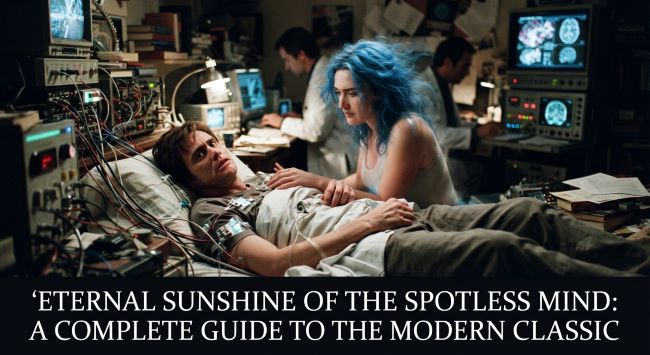
The bulk of the film takes place during that overnight procedure, inside Joel’s mind, as technicians work through his apartment while his memories of Clementine are systematically deleted. The memories are erased in reverse chronological order, beginning with the bitter final days of the relationship and working backward toward the happier early moments.
And here is the film’s devastating turn: as the procedure reaches the good memories, Joel realizes he does not want to lose them after all. He begins trying to hide Clementine in parts of his memory the procedure is not targeting, fleeing through his own recollections in an increasingly desperate attempt to preserve something of her.
Running alongside this is a subplot involving the Lacuna staff, whose own entanglements and ethical failures add another dimension. The structure is deliberately non-linear and initially disorienting, which is entirely intentional: the film wants you to experience something of the confusion of a mind being unmade.
The Cast and Performances
A major reason the film endures is the strength of its performances, several of which are career highlights.
Jim Carrey as Joel Barish. This was a revelation for audiences who knew Carrey primarily as a broad comic performer. His Joel is quiet, withdrawn, sad, and deeply sympathetic, a performance built on restraint rather than energy. Many consider it the finest dramatic work of his career, and it demonstrated a range that surprised even his admirers.
Kate Winslet as Clementine Kruczynski. Winslet’s Clementine is impulsive, vivid, funny, and prickly, with her constantly changing hair color serving as a visual marker of the film’s timeline. Crucially, the character resists being a simple manic-pixie fantasy: she explicitly pushes back on the idea that she exists to fix someone else’s life, a self-aware touch that has aged remarkably well. Winslet received an Academy Award nomination for Best Actress for the role.
Kirsten Dunst as Mary, a Lacuna receptionist whose own storyline carries significant thematic weight.
Mark Ruffalo as Stan, a Lacuna technician.
Elijah Wood as Patrick, another technician whose behavior forms one of the film’s most uncomfortable and pointed threads.
Tom Wilkinson as Dr. Howard Mierzwiak, the founder of Lacuna.
The ensemble works because each performer plays their part straight, letting the strangeness of the premise land emotionally rather than comically. The casting of Carrey against type remains one of the film’s most discussed choices, and it is central to why Eternal Sunshine of the Spotless Mind works as well as it does.
Charlie Kaufman’s Screenplay
The screenplay is the film’s foundation, and it won the Academy Award for Best Original Screenplay, shared by Charlie Kaufman, Michel Gondry, and Pierre Bismuth. Kaufman was already known for inventive, cerebral scripts including Being John Malkovich and Adaptation, and this remains arguably his most emotionally accessible work.
What distinguishes the writing in Eternal Sunshine of the Spotless Mind is that its formal cleverness always serves feeling rather than replacing it. The non-linear structure is not a puzzle to be solved for its own sake; it exists because the story is about how memory actually works, jumping, fragmenting, and reordering itself. The dialogue is naturalistic and often painfully recognizable, capturing the specific rhythms of how couples argue, tease, and wound each other.
The script also refuses easy resolution. It does not suggest that love conquers all, nor that the characters have been fixed by their ordeal. What it offers instead is something more honest and more moving, which is a large part of why the film has such staying power.
Michel Gondry’s Direction and Visual Style
If Kaufman provided the emotional architecture, Michel Gondry provided the visual imagination that makes Eternal Sunshine of the Spotless Mind unforgettable. Gondry came from music videos, and he brought a distinctive approach to depicting the inside of a mind.
Crucially, he achieved most of the film’s memory-collapse effects practically rather than through heavy digital work. Objects vanish, faces blur out, rooms dissolve, and environments fall apart around the characters, largely accomplished through in-camera tricks, forced perspective, clever staging, lighting, and editing. A bookshop empties of its titles. A house on a beach collapses. Joel shrinks to a child’s perspective in a kitchen.
This practical approach gives the film a handmade, tactile quality that digital effects would likely have flattened. The memory sequences feel dreamlike and slightly wrong in exactly the way dreams and fading recollections do. Combined with cinematographer Ellen Kuras’s intimate, often handheld camerawork, the visual language of Eternal Sunshine of the Spotless Mind feels intimate rather than spectacular, which suits a story taking place inside one man’s head.
The score by Jon Brion, delicate and melancholy, completes the effect, and it remains one of the most recognizable film scores of its era.
The Themes
The reason people keep returning to Eternal Sunshine of the Spotless Mind is that its themes are genuinely substantial:
Whether pain is the price of love. The central question is simple and profound: if you could remove the memory of a relationship that hurt you, should you? The film’s answer is complicated, but it clearly suggests that the pain and the joy cannot be separated, and that erasing one erases the other.
How memory shapes identity. As Joel’s memories disappear, something of him disappears too. The film treats memory not as a recording of experiences but as the material we are actually made of.
The unreliability of memory. Memories in the film shift and distort as they are revisited, which is precisely how human memory behaves. What we remember is reconstructed rather than retrieved.
Repetition in relationships. One of the film’s most unsettling implications is that the same two people, meeting again with no memory of what happened, might make many of the same choices and the same mistakes. Character is not so easily erased.
Accepting imperfection. The ending, without spoiling it, is fundamentally about choosing to proceed with full knowledge that things may go badly, which many viewers find quietly devastating and ultimately hopeful.
These ideas give Eternal Sunshine of the Spotless Mind a depth that rewards rewatching. Many viewers report that the film means something different to them at different points in their lives, which is a hallmark of genuinely great work.
The Supporting Storyline
One element of Eternal Sunshine of the Spotless Mind that first-time viewers often underestimate is the Lacuna subplot. While Joel’s memories are being erased, the technicians and staff running the procedure have their own night unfolding in his apartment: drinking, dancing, and behaving with a casualness that sits uncomfortably against the intimacy of what they are deleting.
Patrick, played by Elijah Wood, provides the film’s most genuinely disturbing thread. Having learned everything about Clementine through Joel’s erased memories, he uses that knowledge to pursue her himself, repeating Joel’s words and recreating his moments. It is a quietly horrifying idea about consent and the theft of intimacy, and it complicates any reading of the technology as harmless.
Mary, played by Kirsten Dunst, carries the subplot’s emotional payload. Her storyline delivers a revelation that reframes the entire premise, demonstrating the procedure’s consequences from a completely different angle and raising the ethical questions the film only implies elsewhere. What initially looks like comic relief turns out to be structurally essential, which is why the film rewards a second viewing so richly.
The Ending and What It Means
Without spoiling the specifics, the conclusion of Eternal Sunshine of the Spotless Mind is what elevates it from clever to profound. The film arrives at a moment where its characters are confronted with knowledge about their own future, and must decide what to do with it.
What makes the ending so affecting is its refusal of both cynicism and easy optimism. It does not promise that things will work out, nor does it suggest the characters have learned enough to avoid repeating themselves. Instead it offers something smaller and truer: the choice to proceed anyway, with open eyes.
That final note has been interpreted countless ways over the years, and part of the film’s endurance is that it genuinely supports multiple readings. Some viewers find it hopeful, others heartbreaking, and many find it both simultaneously. The ambiguity is not evasion but precision, since the question of whether love is worth its eventual pain does not have a single answer.
The Awards and Reception
Eternal Sunshine of the Spotless Mind was well received on release and its reputation has grown substantially since. It won the Academy Award for Best Original Screenplay, and Kate Winslet was nominated for Best Actress. Critics praised its originality, emotional intelligence, and the performances, particularly Carrey’s dramatic turn.
Over the following two decades, the film’s standing has risen considerably. It appears regularly on lists of the greatest films of the twenty-first century, and it is frequently cited as one of the best romantic films ever made. It has also become a genuine cultural touchstone, referenced constantly in discussions about love, memory, and heartbreak.
Part of this growing reputation comes from how well the film has aged. Its emotional honesty has not dated, its practical effects still look distinctive rather than obsolete, and its self-aware handling of its female lead reads as ahead of its time. Few films from 2004 feel as contemporary as Eternal Sunshine of the Spotless Mind does now.
Why It Resonates So Deeply
Plenty of films examine relationships; few capture the texture of one so precisely. What makes Eternal Sunshine of the Spotless Mind hit so hard for so many viewers is its specificity. The arguments between Joel and Clementine are not movie arguments, they are recognizable ones, full of petty jabs and old wounds and things said to hurt. The good memories are similarly ordinary: lying on a frozen river, talking in a kitchen, the small moments that actually constitute a relationship rather than the grand ones.
The film also understands that people rarely fall out of love cleanly. Joel’s realization mid-procedure that he wants to keep his memories, even the painful ones, mirrors an experience most people recognize: the impulse to be rid of someone colliding with the knowledge that they mattered.
There is also a generosity in how the film treats its characters. Neither Joel nor Clementine is the villain of the relationship. Both are difficult in their own ways, both contribute to its collapse, and both are treated with sympathy. That refusal to assign blame is unusual and is part of why the film feels true.
Watching It for the First Time
For anyone approaching Eternal Sunshine of the Spotless Mind for the first time, a few things help:
- Accept the initial confusion. The opening stretch deliberately withholds information, and the structure only becomes clear as the film progresses. That disorientation is intentional.
- Watch Clementine’s hair. Her changing hair color is the most reliable indicator of where you are in the timeline, a clever practical solution to a structural challenge.
- Do not expect a conventional romance. The film is romantic, but it is also sad, strange, and unsentimental.
- Pay attention to the Lacuna subplot, which initially seems like a distraction and turns out to be thematically essential.
- Expect to want to rewatch it. Most viewers find the second viewing substantially richer, since knowing the structure lets you appreciate how carefully it is built.
Its Legacy and Influence
The influence of Eternal Sunshine of the Spotless Mind is visible across the two decades of film and television that followed it. Its blend of speculative premise with intimate emotional storytelling became a template, particularly for stories that use science fiction concepts to examine relationships and memory. Numerous later films and series owe something to its approach of grounding a high-concept idea in ordinary human feeling.
It also permanently changed how audiences saw Jim Carrey, opening the door for the dramatic work he has done since. And it cemented Charlie Kaufman as one of the most distinctive voices in American screenwriting, while establishing Michel Gondry’s visual style for a wide audience.
Perhaps most tellingly, the film has entered everyday conversation. The idea of wanting to erase a memory of someone, and the recognition that doing so would cost you something precious, is now a reference point people reach for instinctively when discussing heartbreak. Few films achieve that level of cultural absorption.
The bottom line on Eternal Sunshine of the Spotless Mind is that it is a genuine modern classic that earns its reputation: a 2004 film directed by Michel Gondry from Charlie Kaufman’s Oscar-winning screenplay, starring Jim Carrey in a career-best dramatic performance opposite an Oscar-nominated Kate Winslet. Using an inventive science fiction premise about erasing memories, it delivers one of cinema’s most emotionally honest examinations of love, loss, memory, and whether the pain of a relationship is worth the joy that came with it. Visually inventive, structurally daring, and deeply moving, it is a film that rewards rewatching and continues to feel remarkably contemporary two decades on.
Key Takeaways
- Eternal Sunshine of the Spotless Mind is a 2004 romantic science fiction drama directed by Michel Gondry, written by Charlie Kaufman.
- It stars Jim Carrey as Joel and Kate Winslet as Clementine, a couple who each have their memories of the other erased.
- Most of the film takes place inside Joel’s mind during the erasure procedure, as he tries to hide his memories of Clementine.
- The title comes from a line in Alexander Pope’s poem Eloisa to Abelard, about the supposed bliss of forgetting.
- The screenplay won the Academy Award for Best Original Screenplay, and Winslet was nominated for Best Actress.
- The supporting cast includes Kirsten Dunst, Mark Ruffalo, Elijah Wood, and Tom Wilkinson as the Lacuna staff.
- Gondry achieved the memory-collapse effects largely through practical, in-camera techniques rather than digital work.
- Its themes include whether pain is the price of love, how memory shapes identity, and the repetition of patterns in relationships.
- Carrey’s restrained dramatic performance was a revelation for audiences who knew him for broad comedy.
- The film’s reputation has grown steadily, and it is now regularly named among the greatest films of the twenty-first century.