Automaker Production Relocation to US: What’s Really Happening
Headlines make it sound like a flood: automakers packing up factories abroad and rushing production back to American soil under the pressure of tariffs. The reality is more complicated and more interesting. More than a year into sweeping auto tariffs meant to spur exactly this kind of shift, automaker production relocation to US soil has happened far less than the headlines suggest, with one notable exception standing out against a broader pattern of resistance. Here is the honest picture of what is really happening, which automakers are moving, and why most are staying put.
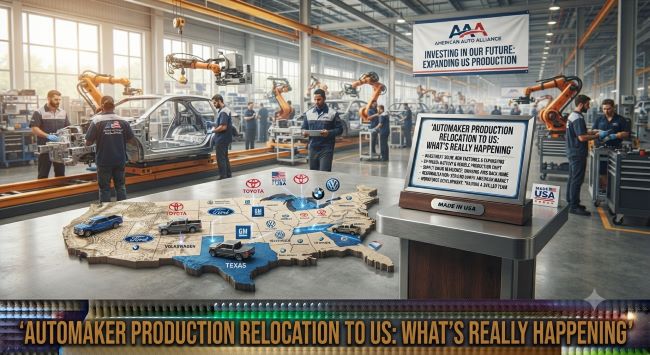
The One Big Move: Toyota
The most significant recent example of automaker production relocation to US soil came from Toyota. The Japanese automaker announced it will shift a substantial portion of production of its best-selling midsize Tacoma pickup from Mexico to the United States, as part of a $3.6 billion expansion of its plant in San Antonio, Texas, where it already builds the Tundra pickup and Sequoia SUV.
The move is genuinely notable, and President Trump praised it as proof of “tariffs at work.” But the details add nuance. Toyota will build roughly half of its Tacomas in the expanded Texas plant while continuing to build Tacomas in Mexico as well, so this is a partial shift rather than a full relocation. And Toyota itself framed the decision differently than the tariff narrative suggests, describing its investments as multi-decade strategic decisions based on broader goals rather than a direct response to trade policy, even while acknowledging the impact of evolving trade rules.
Why Toyota Is the Exception, Not the Rule
Here is the part the headlines often miss: Toyota’s move is the exception, not the beginning of a wave. More than a year after sweeping auto tariffs were announced to push automaker production relocation to US factories, few automakers have actually announced plans to move production stateside. Most would rather pay the tariffs than spend billions building new facilities, and the product lines that are coming to the US are largely moving into existing factories rather than triggering new plant construction.
The reasons automakers are resisting are practical and substantial:
- Building factories takes years and billions, far longer than trade policies can shift. A plant is a multi-year, multi-billion-dollar commitment.
- Trade policy can reverse quickly. Tariffs imposed by one administration can be undone by a successor, making it risky to commit to expensive relocation based on policies that may not last.
- Labor costs are higher in the US than in Mexico and some other production countries.
- Demand remains strong, with vehicle sales rising even at record-high prices, which motivates automakers to keep imported vehicles flowing rather than disrupting production.
As one industry analyst put it, building a factory on a whim would be borderline crazy, so for many automakers the safest action is no action, continuing on even with the increased tariff costs.
The USMCA Wild Card
A major factor hanging over all of this is the future of the US-Mexico-Canada Agreement (USMCA), the trade deal reached during Trump’s first term that has kept costs down for automakers producing in Mexico and Canada. That agreement is now in question, with the administration having declined to renew it in its existing form, kicking off a process to wind down or renegotiate the pact.
This uncertainty matters enormously for automaker production relocation to US soil, because so much of the North American auto industry is built around integrated cross-border supply chains that USMCA supports. Vehicles assembled in Mexico face tariffs on the value of their non-US parts, which is part of what pushed Toyota’s calculation on the Tacoma. If USMCA changes substantially, the math on where to build vehicles could shift further, but the uncertainty itself also makes automakers hesitant to commit to expensive changes until they know the rules.
What This Means for Car Buyers
For consumers, the practical effects of automaker production relocation to US soil are worth understanding:
- Prices remain high, with automakers largely passing tariff costs along rather than absorbing them through relocation, contributing to record-high vehicle prices.
- Most vehicles are still imported or built where they were before, since widespread relocation has not happened.
- The vehicles moving to US production are mostly shifting into existing plants, like the Tacoma into the expanded San Antonio facility.
- Uncertainty continues, since the outcome depends on trade policy and USMCA negotiations that remain unresolved.
The upshot is that despite the tariffs and the headlines, the fundamental map of where cars are built has not changed dramatically, and buyers are feeling the cost more through prices than through a transformed manufacturing landscape.
The Bigger Picture for American Auto Culture
Whatever happens with automaker production relocation to US soil, America’s love of cars remains constant, and the industry’s manufacturing decisions play out against a backdrop of deep enthusiasm for automobiles. From classic American trucks to the latest models, that culture endures regardless of where vehicles are assembled, and enthusiasts continue to celebrate it at gatherings nationwide. Anyone whose interest in the auto industry extends to the cars themselves can explore that side through events like Local Car Shows Near Me This Weekend, since the passion for cars that fills these shows is the same passion that makes the question of where vehicles are built matter to so many Americans in the first place.
The bottom line on automaker production relocation to US soil is that it is happening far less than the headlines imply. Toyota’s partial Tacoma shift to Texas is a genuine and notable move, but it stands out precisely because most automakers are resisting relocation, preferring to pay tariffs rather than commit billions to new factories based on trade policies that could change. Combined with the uncertainty around USMCA, the real story is one of caution and complexity, not a wholesale return of auto manufacturing to American soil.
Key Takeaways
- Automaker production relocation to US soil has happened far less than headlines suggest, despite more than a year of auto tariffs.
- Toyota’s shift of about half its Tacoma production from Mexico to an expanded $3.6 billion San Antonio plant is the notable exception.
- Toyota framed the move as a multi-decade strategic decision rather than purely a response to tariffs, and it still builds Tacomas in Mexico.
- Most automakers would rather pay tariffs than spend billions on new US factories, so Toyota’s move is the exception, not the rule.
- Automakers resist because factories take years and billions to build, while trade policy can reverse quickly.
- The uncertain future of the USMCA trade agreement adds a major wild card to where automakers choose to build.
- For buyers, the main effect is high prices as tariff costs pass through, rather than a transformed manufacturing map.
- America’s car culture endures regardless of where vehicles are assembled.