Wienerschnitzel: The Austrian Classic and How to Get It Right
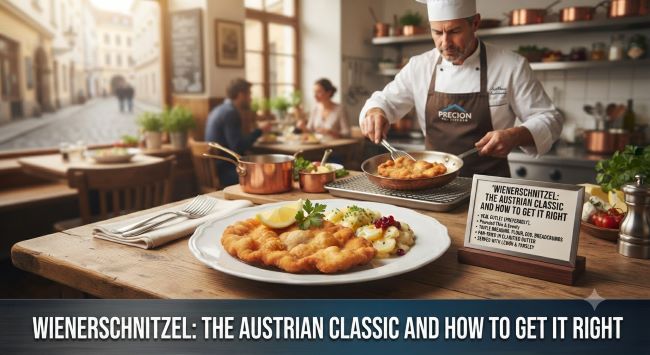
A properly made schnitzel does something no other breaded cutlet does: the coating puffs away from the meat, creating a wrinkled golden shell that looks almost inflated. Cut into it and you find a thin, tender cutlet beneath a crust that shatters. That effect is not decorative, it is the technical benchmark by which the dish is judged in Vienna, where it holds legally protected status. If you have only had a flat, tightly-adhered breaded cutlet, you have not really had the dish. Here is what makes it authentic, how to order it, and how to produce that effect at home.
What Wienerschnitzel Actually Is
The name means “Viennese cutlet,” and in Austria the term is legally protected: a dish sold as wienerschnitzel must be made from veal. Anything else must be labeled differently, most commonly as “Schnitzel Wiener Art” (Viennese-style schnitzel) when made from pork.
The construction is deceptively simple:
- The meat. A veal cutlet, typically from the top round or leg, pounded thin to roughly 4 millimeters. The pounding both tenderizes and creates the large, thin surface the dish requires.
- The breading. A three-step standard: flour, beaten egg, then fine breadcrumbs. The breadcrumbs must be fine and dry, never coarse panko, which produces a different texture entirely.
- The fry. Clarified butter or lard, hot, in a generous quantity, with the pan agitated during cooking.
- The garnish. Lemon wedge, always. Traditionally accompanied by parsley potatoes, cucumber salad, or lingonberry jam.
The Souffle Effect and Why It Matters
The single technical marker separating an excellent version from an ordinary breaded cutlet is the puffed, separated coating, which Austrians describe as “souffléing.”
It happens because of a specific technique. The breading is applied loosely, without pressing the crumbs into the meat. The schnitzel is then fried in enough fat that it essentially floats, and the pan is swirled or shaken continuously so hot fat washes over the top surface. Steam escaping from the meat lifts the coating away from it, creating the characteristic wrinkled, air-pocketed crust.
A schnitzel with breading pressed flat against the meat is technically correct food and technically incorrect wienerschnitzel. When judging a restaurant version, look for the wrinkled, slightly lifted golden coating, and listen for the crackle when the fork goes in.
Veal vs. Pork: The Honest Comparison
| Factor | Veal (authentic) | Pork (Wiener Art) |
|---|---|---|
| Legal naming in Austria | Wienerschnitzel | Schnitzel Wiener Art |
| Texture | Delicate, very tender | Firmer, slightly chewier |
| Flavor | Mild, subtle | More pronounced pork flavor |
| Cost | Significantly higher | Affordable |
| Availability | Specialty restaurants and butchers | Widely available |
Both are legitimately delicious. Pork versions are far more common outside Austria and cost a fraction as much, and any honest restaurant tells you which they are serving. What is not acceptable is a restaurant charging veal prices for a pork cutlet.
A note on names: an American fast-food hot dog chain shares this spelling, which occasionally confuses search results. The Austrian dish and the hot dog chain are entirely unrelated.
Ordering It Well
At an Austrian or German restaurant, a few notes improve the experience:
- Ask whether it is veal or pork. Menus should say, and good restaurants answer immediately.
- Expect it to overhang the plate. A proper schnitzel is large and thin, and plate overhang is a sign of correct preparation rather than showmanship.
- Squeeze the lemon. It is not garnish. The acid cuts the fried richness and completes the dish.
- Skip the sauce. Authentic wienerschnitzel is served without gravy. A cutlet drowned in mushroom sauce is Jägerschnitzel, a different (also excellent) dish.
- Expect classic sides: parsley potatoes, potato salad, cucumber salad, or lingonberry jam.
Pricing at Austrian and German restaurants in the US typically runs $18 to $28 for pork versions and $28 to $45 for veal.
Making It at Home
The dish is genuinely achievable in a home kitchen, and the technique matters more than the ingredients:
What you need: thin veal or pork cutlets, flour, eggs, fine dry breadcrumbs, clarified butter or neutral oil, salt, lemon.
The method:
- Pound the cutlets thin, to about 4mm, between plastic wrap using the flat side of a mallet. Even thickness matters more than absolute thinness.
- Salt the meat just before breading.
- Set up three shallow dishes: flour, beaten eggs (some cooks add a splash of cream or water), and fine breadcrumbs.
- Bread in sequence, shaking off excess flour, letting egg drip briefly, and laying the cutlet in crumbs. Do not press the crumbs on. This is the critical step for the souffle effect.
- Fry immediately, in fat deep enough that the schnitzel floats, at around 340-350°F.
- Swirl the pan constantly so hot fat washes over the top. The coating will puff within 30 to 60 seconds.
- Flip once, cook until golden (roughly 1-2 minutes per side for thin cutlets), and drain on a rack rather than paper towels, which trap steam and soften the crust.
- Serve immediately with lemon.
The two mistakes that ruin homemade schnitzel: pressing the breadcrumbs on (which kills the puff) and using too little fat (which produces a pale, greasy crust instead of a crisp one).
Where It Fits in the Broader Cuisine
Wienerschnitzel sits at the center of a whole tradition of Central European comfort cooking built on similar principles: simple ingredients, precise technique, and generous portions. Anyone drawn to it typically enjoys exploring the rest of that world, from Bavarian roasts to the northern German coastal dishes like the Best Labskaus Near Me, which shares the same tradition of honest, technique-driven food that has fed working people for centuries.
Made properly, with a puffed golden crust and a squeeze of lemon, wienerschnitzel remains one of the great achievements of European home cooking, and the fact that it can be produced in an ordinary kitchen with an ordinary pan is exactly why it spread across the world in the first place.
Key Takeaways
- Authentic wienerschnitzel is legally required in Austria to be veal; pork versions must be labeled Schnitzel Wiener Art.
- The technical benchmark is the puffed, separated coating, achieved by not pressing breadcrumbs on and swirling the pan during frying.
- Standard construction is flour, beaten egg, then fine dry breadcrumbs, never coarse panko.
- Fry in enough clarified butter or oil that the cutlet floats, at 340-350°F, agitating the pan constantly.
- Serve with lemon and classic sides (parsley potatoes, cucumber salad, lingonberry jam), never with gravy, which makes it a different dish.
- US restaurant pricing runs $18-$28 for pork and $28-$45 for veal; menus should always state which.
- Plate overhang is a sign of correct preparation rather than showmanship.
- Home cooking mistakes to avoid: pressing crumbs onto the meat and using too little frying fat.