How to Fold a Pocket Square: 5 Classic Folds Every Man Should Know
A well-folded pocket square is one of the most effective small details for elevating a suit or sport coat, and learning a handful of reliable, classic folds gives you genuine versatility to match different occasions, fabric types, and overall styling intentions without needing to memorize an overwhelming number of techniques. This guide covers five of the most popular and genuinely useful pocket square folds, from the simplest to slightly more elaborate options.
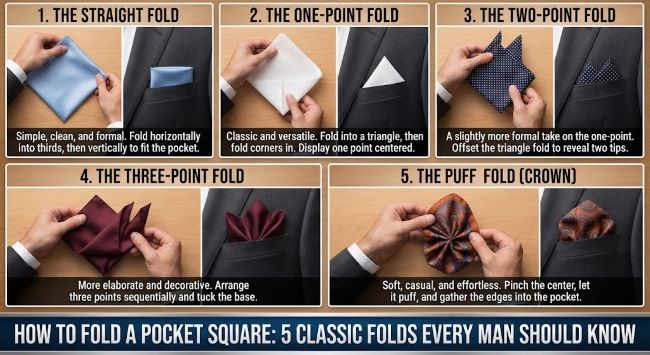
The Straight (Square) Fold
The simplest, most classic, and most universally appropriate fold, suitable for nearly any occasion from business settings to formal events.
Step 1: Lay your pocket square flat, right side facing down.
Step 2: Fold the square in half, bringing the bottom edge up to meet the top edge, creating a rectangle.
Step 3: Fold in half again in the same direction, creating a smaller rectangle.
Step 4: Fold the resulting rectangle into thirds (folding each end inward toward the center) to create a width appropriate for your specific pocket size.
Step 5: Insert into your breast pocket with the folded edge facing up, adjusting the height so a clean, straight line of fabric shows above the pocket edge.
The Puff (Casual Pouf) Fold
A relaxed, slightly more casual-looking fold that works well for situations where the very crisp precision of the straight fold might feel slightly too formal.
Step 1: Lay the pocket square flat, then pinch the center of the fabric with your fingers, lifting it up.
Step 2: Allow the rest of the fabric to drape down naturally around your pinched center point, letting it fall into loose, soft folds rather than crisp, structured lines.
Step 3: Gather the loose fabric below your pinch point and fold it under, creating a base that will sit inside the pocket.
Step 4: Insert into your pocket with the puffed top portion visible above the pocket edge, adjusting the puff’s fullness and shape by hand until it looks naturally relaxed rather than overly structured.
The Two-Point Fold
A slightly more formal, structured look that displays two distinct points above the pocket, offering a bit more visual interest than the straight fold while remaining genuinely appropriate for most business and semi-formal settings.
Step 1: Lay the square flat in a diamond orientation (rotated 45 degrees from the straight fold’s starting position).
Step 2: Fold the bottom point up to meet partway up the square, creating a flattened bottom edge with the top point still extending upward.
Step 3: Fold the left and right sides inward toward the center, creating a narrower vertical shape with two points (the original top point and a secondary point created by the folding) visible at the top.
Step 4: Fold the bottom up to an appropriate height for your pocket, then insert with the two points visible above the pocket edge.
The Three-Point Fold
A more elaborate, formal variation building on the two-point fold’s general technique, displaying three distinct points for a more visually striking, detailed presentation suited to more formal occasions specifically.
Step 1: Begin similarly to the two-point fold, starting in a diamond orientation.
Step 2: Fold the square diagonally to create an initial triangular base shape.
Step 3: Fold the two outer corners of the triangle inward and slightly upward at staggered heights, creating three distinct points of varying or matched height at the top of the folded square.
Step 4: Fold the bottom portion up and tuck it to create a stable base, then insert into the pocket with all three points visible and appropriately spaced above the pocket edge.
The Presidential (Flat) Fold
Despite its more elaborate-sounding name, this is actually one of the simplest and most minimal folds, named for its association with formal political and diplomatic settings where understated elegance is specifically preferred over more visually elaborate folding styles.
Step 1: Fold the pocket square in half, then in half again, creating a smaller rectangle, similar to the early steps of the straight fold.
Step 2: Continue folding into a narrow rectangle sized appropriately to fit cleanly within your pocket with minimal visible fabric.
Step 3: Insert into the pocket so that only a clean, flat, minimal strip of fabric is visible along the top edge, without any additional shaping, puffing, or pointed details.
Choosing the Right Fold for the Occasion
Business and professional settings generally call for the straight fold or the presidential fold, both offering a clean, understated, professional appearance without excessive visual flourish.
Semi-formal and social occasions (weddings as a guest, dinner parties, cocktail events) work well with the two-point fold or the puff fold, offering slightly more visual interest while remaining broadly appropriate.
Formal events (black-tie occasions, more elaborate weddings) can accommodate the three-point fold or other more elaborate styling choices, where a more visually detailed presentation is generally more fitting with the overall formality of the occasion’s dress expectations.
Fabric Considerations
Silk pocket squares generally hold more elaborate folds (like the three-point fold) with better structure and crispness compared to softer fabrics, making silk a particularly good choice when you’re attempting one of the more detailed folding techniques.
Linen and cotton pocket squares tend to work particularly well with the puff fold specifically, since their more relaxed, textured drape naturally suits a softer, less structured presentation compared to silk’s crisper, more architecturally precise folding capability.
Practice with an inexpensive practice square first if you’re learning a new, more complex fold, since the more elaborate techniques specifically benefit from some hands-on repetition before attempting them with your nicer pocket squares or right before you need to actually wear the result to an event.
Key Takeaways
- The straight (square) fold is the simplest, most universally appropriate option, suitable for nearly any business or formal occasion
- The puff fold offers a relaxed, casual presentation that works well when the precision of structured folds feels slightly too formal for the occasion
- The two-point and three-point folds offer increasingly elaborate, visually detailed presentations suited to semi-formal and formal occasions respectively
- The presidential (flat) fold is deceptively simple despite its name, offering minimal, understated elegance particularly associated with formal political and diplomatic settings
- Silk pocket squares hold more elaborate, structured folds better than softer fabrics, while linen and cotton squares work particularly well with the more relaxed puff fold specifically
- Practice more complex folds with an inexpensive practice square first, since elaborate techniques like the three-point fold benefit genuinely from some hands-on repetition before attempting them for an actual event
- Match your fold choice to the occasion’s formality: straight or presidential for business, two-point or puff for semi-formal, and three-point or other elaborate styles for genuinely formal events