Hands Free Breast Pump: A Complete Buying Guide
Hands free breast pumps have changed the daily reality of pumping for a huge number of parents, eliminating the need to sit tethered to a wall outlet and a tube system for 15-30 minutes multiple times a day. Whether you’re returning to work, managing a busy household, or simply want your hands back during pumping sessions, understanding how these pumps work and what separates a good one from a frustrating one will save you money and disappointment.
What Makes a Breast Pump “Hands Free”
True hands-free pumps fall into two main categories:
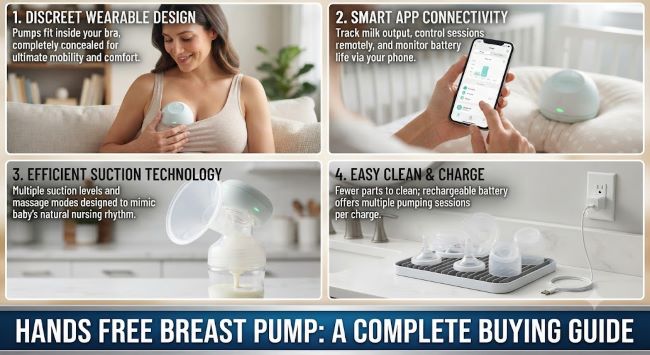
Wearable, in-bra pumps. These are self-contained units that sit entirely inside your bra (or a pumping bra) with no external tubing, no external motor, and no connection to a wall outlet during use. The entire mechanism — motor, collection container, and flange — is built into one compact unit worn directly against the breast. Examples include the Elvie Pump, Willow, and Momcozy S12 Pro.
Wearable cup pumps with external components. Some pumps use a wearable collection cup but still connect via tubing to an external motor unit, which you can clip to a waistband or set in a bag, allowing more freedom of movement than a traditional plug-in pump but not the complete freedom of a fully self-contained wearable pump.
It’s also worth distinguishing both of these from traditional hospital-grade or standard double electric pumps used with a hands-free pumping bra (a bra with built-in openings to hold standard flanges in place). This setup frees your hands but still requires you to be near an outlet (or carry a battery pack) and tethered by tubing to the pump unit — a meaningful difference from a true wearable pump if mobility is your priority.
Key Features to Look For
Suction strength and customization. Look for multiple suction levels and the ability to independently adjust each breast, since output often differs side to side. Stronger, well-reviewed motors maintain more consistent suction throughout a full pumping session rather than losing power partway through.
Battery life and charging. Wearable pumps run on rechargeable batteries. Battery life varies significantly between models, from around 1-2 pumping sessions on a single charge for some budget options to 3-5+ sessions for premium models. If you’ll be pumping multiple times during a workday away from a charging opportunity, battery life should be a top priority in your comparison.
Capacity and spill resistance. Wearable pump collection containers typically hold 4-8 ounces per side. Check that the unit has reliable leak-proof and spill-proof design, since a wearable pump that leaks when you bend over or move around defeats much of its purpose. Read reviews specifically mentioning leak performance during normal movement.
Noise level. One of the more practical, less-discussed factors: some pumps are noticeably loud, which matters if you’re pumping in shared office spaces or want discretion. Reviews mentioning specific noise comparisons (often described relative to a traditional pump or a household appliance) are useful here.
App connectivity. Many premium wearable pumps connect to a smartphone app for tracking pumping sessions, output volume, and remote control of suction settings. This is a genuine convenience for some users and an unnecessary complication for others — consider your own preference for app-based tracking versus simple physical controls.
Flange sizing options. Comfort and output both depend heavily on correct flange fit. Look for pumps offering multiple flange sizes, since an ill-fitting flange (even on an expensive premium pump) reduces both comfort and milk output significantly.
Top Hands Free Breast Pump Options by Budget
Premium tier ($400-$550): Elvie Pump and Elvie Stride. Among the quietest and most discreet wearable pumps available, with strong app integration and a well-regarded design. The premium price reflects genuinely strong build quality and suction performance, making it a frequently recommended option for parents who pump regularly and want to minimize daily friction.
Premium tier: Willow Go and Willow 3.0. Known for a spill-proof design that works at any angle, including while leaning forward, which is a meaningful practical advantage for active parents. The Willow Go offers reusable milk bags as part of its collection system, an alternative to bottle-based collection some parents prefer.
Mid-range ($150-$250): Momcozy S12 Pro and similar wearable models. Momcozy has become one of the most popular mid-range options, offering strong suction performance and reasonable battery life at a significantly lower price point than the premium tier, making it a frequently recommended budget-conscious alternative without sacrificing core functionality.
Mid-range: BabyBuddha and Spectra wearable attachments. Spectra, known primarily for traditional plug-in pumps, also offers wearable cup attachments compatible with their standard pump motors, letting parents who already own a Spectra pump add hands-free functionality without buying an entirely separate device.
Budget tier (under $100): Various wearable cup pumps from brands like Bellababy and similar. Budget options can work adequately for occasional or backup pumping use, though battery life, suction consistency, and build quality typically don’t match mid-range and premium options for parents pumping multiple times daily over an extended period.
Insurance Coverage for Breast Pumps
Under the Affordable Care Act, most health insurance plans in the US are required to cover a breast pump, though coverage specifics (which models, rental vs. purchase, reimbursement process) vary by insurer. Many insurers cover only standard double electric pumps or have a limited list of covered wearable pump models, sometimes requiring a copay or the difference between the covered amount and a premium pump’s full price.
Check with your insurance provider directly, since coverage for wearable hands-free pumps specifically (as opposed to traditional plug-in pumps) varies more than coverage for standard pumps. Some insurers have expanded wearable pump coverage in recent years as these products have become more mainstream, but it’s not universal.
Choosing Based on Your Pumping Situation
Returning to work in an office: prioritize discretion (noise level, size under clothing) and battery life sufficient for a full workday’s pumping sessions without access to charging.
Primarily pumping at home: battery life matters less since charging access is constant; prioritize comfort, suction quality, and ease of cleaning for daily use.
Exclusively pumping (replacing breastfeeding entirely): invest in a higher-capacity, higher-performance pump since you’ll rely on it for your baby’s full milk supply rather than supplemental pumping; suction consistency and reliability become more critical at this volume of use.
Occasional or backup pumping: a mid-range or budget option is often entirely adequate since the pump won’t see the wear of daily multi-session use.
Key Takeaways
- True hands-free breast pumps are wearable, self-contained units worn entirely inside the bra with no external tubing or wall connection required during use
- Key comparison factors include suction strength and customization, battery life, leak resistance, noise level, and available flange sizing for proper fit
- Premium options (Elvie, Willow) offer the strongest performance and discretion at $400-$550; mid-range options (Momcozy, Spectra wearable attachments) provide solid functionality at $150-$250
- Battery life requirements depend heavily on your pumping situation: workplace pumping without charging access demands significantly more battery capacity than home-based pumping
- Most insurance plans cover breast pumps under the ACA, but wearable pump coverage specifics vary significantly by insurer — confirm directly before assuming a specific model is covered
- Correct flange sizing matters as much as pump quality for both comfort and milk output; look for pumps offering multiple flange size options rather than a single fixed size
- Match your pump choice to your actual pumping frequency and setting: exclusive pumpers need different priorities than parents doing occasional supplemental sessions