Best Labskaus Near Me: Finding This Rare Hamburg Dish Outside Germany
Labskaus is the kind of dish that inspires passionate loyalty from the people who grew up eating it and puzzled curiosity from everyone else. It’s a traditional sailor’s food from Hamburg and the northern German coast: a mixture of corned beef, potatoes, and pickled beet mashed together and topped with a fried egg, pickled herring, and gherkins. It looks unlike anything in most people’s culinary experience and tastes deeply savory, slightly tangy, and unmistakably of the sea. If you’ve been searching for the best labskaus near me, this guide will tell you where to look and what to expect.
What Labskaus Is
The dish traces its origins to the sailing ships of the 18th and 19th centuries, when long ocean voyages required food that could be preserved without refrigeration. Corned beef, pickled beets, and pickled herring were all long-lasting provisions aboard northern European ships, and labskaus developed as a way to combine these ingredients into a filling, calorie-dense meal.
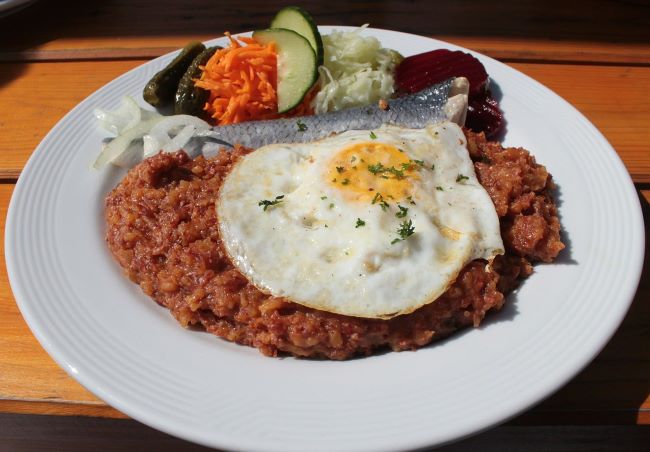
The base is corned beef and potatoes mashed together until they form a cohesive, deep reddish-purple mass. The color comes from the pickled beet (Rote Bete) blended into the mix. The texture is dense and unified, unlike a simple corned beef hash where the ingredients remain identifiable. On top: a fried egg (usually sunny side up), rollmops (pickled herring), and gherkins. The combination of the rich, salty beef-potato base with the tartness of the herring and pickles is the defining flavor experience.
Labskaus is a regional dish with strong cultural identity in Hamburg, Bremen, and surrounding coastal areas of northern Germany. Outside Germany, particularly outside communities with German immigrant history, finding labskaus near me requires specifically targeting German restaurants rather than broad European dining.
Where to Find Labskaus Near You
German restaurants. The most reliable source for the best labskaus near me is a German restaurant, specifically one that takes its menu seriously rather than offering a simplified version of German food for broad appeal. Look for restaurants that list regional German specialties rather than just schnitzel and bratwurst: a menu that includes labskaus is a menu that’s trying to represent actual German cuisine.
In the United States, German immigrant communities established themselves across the Midwest (particularly Wisconsin, Minnesota, Ohio, Indiana, and Illinois), Pennsylvania, and Texas. These areas have the highest concentration of German restaurants where labskaus might appear, particularly in cities with historical German neighborhoods.
German cultural organizations and clubs. German-American clubs, German cultural centers, and organizations with ties to Hamburg specifically sometimes host dinners or events where traditional regional food is prepared. These events are often more reliable sources of genuinely traditional labskaus than restaurant menus.
Oktoberfest events. Major Oktoberfest celebrations in cities with German communities sometimes include labskaus among specialty food vendors, particularly vendors trying to represent northern German food culture rather than just Bavarian food (which is the most commonly represented German regional cuisine at Oktoberfest events).
Specialty German delis and markets. Some German specialty food importers and delicatessens carry canned or jarred versions of labskaus for home preparation. While this isn’t the restaurant experience, it provides access to the dish in areas without German restaurants.
Searching for Labskaus Online
Google Maps search for “German restaurant” in your area produces the starting point. From there, checking each restaurant’s menu for labskaus specifically is necessary since it’s not a standard item at every German restaurant.
Yelp’s German cuisine filter surfaces options, though the keyword search for labskaus specifically is hit or miss depending on whether restaurants have uploaded full menus. Calling German restaurants directly and asking is often more efficient than searching online menus.
German-American community Facebook groups and city-specific German expat groups online are worth asking directly. Members of these communities know which local restaurants serve authentic regional food and will often share that information when asked.
What a Proper Labskaus Looks Like
The color. The base should be a deep, uniform reddish-purple from the pickled beet blended through the corned beef and potato. A labskaus that’s grey or beige has too little beet or no beet at all, which changes both the visual character and the flavor balance.
The texture. The base should be mashed together completely: not chunky like a hash but not entirely smooth either. A slight texture is authentic. Some versions are more mashed than others by regional and cook preference.
The toppings. A complete labskaus includes: a fried egg (runny yolk preferred, since it blends into the base as you eat), at least one rollmop (pickled herring wrapped around a pickle), and several gherkins. These are not optional garnishes: they’re integral to how the dish is meant to be eaten. The tartness of herring and pickle against the rich, salty base is the flavor balance the dish is built around.
The portion. Labskaus is a hearty sailor’s meal. A restaurant portion should be substantial. A small decorative tasting portion is not what the dish is about.
What to Eat It With
Traditional accompaniments include dark German bread (Schwarzbrot) and a cold German beer, specifically a northern German lager. Hamburg’s local beer culture is pilsner-forward, and a clean, crisp lager is the natural pairing.
The runny egg yolk should be broken over the base as you start eating, where it enriches and softens the salty beef-potato mixture. The herring and gherkin bites in between reset the palate with tartness between mouthfuls of the richer base. This alternating pattern is how the dish is designed to be eaten.
For other traditional European dishes that are genuinely hard to find outside their home regions, best frankfurter with mustard near me covers another northern European food tradition that requires targeted searching to find well-prepared versions outside Germany.
Making Labskaus at Home If You Can’t Find It
If your search for labskaus near me comes up empty, it’s genuinely achievable at home with ingredients available at most grocery stores. The core components — canned corned beef, potatoes, and pickled beets — are all widely available. Rollmops (pickled herring) can be found at specialty European delis, some supermarkets with a wide deli section, or ordered online.
The process: boil potatoes until soft, drain and mash them coarsely. Add canned corned beef and drained, chopped pickled beets and continue mashing until everything is blended into a uniform mixture. Season with salt, pepper, and a touch of the beet liquid for additional tartness. Fry a sunny-side egg in butter in a separate pan.
Plate the base, top with the fried egg, add rollmops and sliced gherkins on the side, and serve with dark bread. The first time you make it you’ll understand exactly why this became a beloved regional dish: simple ingredients, combined correctly, produce something that tastes significantly more interesting than the ingredient list suggests.
Key Takeaways
- Labskaus is a traditional Hamburg sailor’s dish of corned beef, potatoes, and pickled beet mashed together and topped with a fried egg, pickled herring, and gherkins: its deep reddish-purple color comes from the beet
- Finding the best labskaus near me requires targeting German restaurants specifically, particularly those with regionally specific menus rather than simplified broad-appeal German food
- US cities with historical German immigrant communities (Milwaukee, Cincinnati, Chicago, San Antonio, Philadelphia) have the highest concentration of German restaurants where labskaus might appear
- German-American clubs, cultural organizations, and Oktoberfest events with a northern German food focus are secondary sources outside dedicated restaurants
- A proper labskaus has a uniformly reddish-purple mashed base (not grey), a runny fried egg on top, rollmops, and gherkins as integral components rather than optional garnish
- Call German restaurants directly to ask about labskaus: it often doesn’t appear on online menus even when it’s a regular preparation
- Pair with dark German bread and a cold northern German-style lager for the traditional eating experience