Critical Thinking Exercises: Practical Ways to Sharpen Your Mind
Most of us go through the day on autopilot, accepting claims, making snap judgments, and rarely stopping to ask whether our reasoning actually holds up. The ability to pause, question, and reason clearly is a skill, and like any skill, it grows with practice. That is exactly what critical thinking exercises are for. They train your mind to analyze information, spot weak arguments, and reach sounder conclusions, whether you are making a big decision, reading the news, or solving a problem at work.
This guide gives you a practical toolkit. You will find hands-on drills you can start today, real examples to make the ideas concrete, and clear guidance on sharpening it over time. By the end, you will have a routine for sharpening one of the most valuable abilities a person can develop.
What Critical Thinking Really Means
Before the practice, it helps to define the target. Critical thinking is the disciplined process of analyzing information objectively, questioning assumptions, weighing evidence, and reaching a reasoned judgment rather than an emotional or automatic one. It is not about being negative or doubting everything. It is about thinking clearly and fairly.
A strong critical thinker does a few things consistently. They ask questions rather than accepting claims at face value. They look for evidence and consider its quality. They notice their own biases and try to set them aside. They consider alternative explanations before settling on one. And they stay open to changing their mind when better information appears. These habits separate careful reasoning from gut reaction.
The good news is that none of this is fixed at birth. Critical thinking is a skill that strengthens with deliberate effort, which is why structured practice matters so much. Just as workouts build muscle, the right mental drills build reasoning ability over time. That is the whole premise behind treating critical thinking as something you train rather than something you either have or lack.
Why Critical Thinking Matters
It is worth understanding what is at stake, since the payoff touches nearly every part of life. Sharp reasoning makes you better at work, in relationships, and as a citizen navigating a flood of information.
At work, clear thinkers solve problems faster, make better decisions, and spot risks others miss, which is why employers consistently rank the skill among the most valuable they look for. In daily life, the ability to evaluate claims protects you from scams, misinformation, and manipulative marketing. When you can tell a solid argument from a flashy but empty one, you make wiser choices with your money, your health, and your time.
There is a personal benefit too. Thinking clearly reduces the anxiety that comes from confusion and rash decisions, replacing it with a calm sense of control. People who reason well tend to feel more confident in their choices because those choices rest on something solid. In a world overflowing with information and opinion, the ability to sort signal from noise is close to a superpower, and it is one anyone can build.
Critical Thinking Examples in Everyday Life
Abstract definitions only go so far, so let us ground the idea with some critical thinking examples you will recognize. Seeing the skill in action makes it far easier to practice.
Imagine you read a headline claiming a new food cures a disease. A critical thinker pauses to ask who funded the study, how many people it involved, and whether other research agrees, rather than sharing it instantly. That habit of questioning is one of the clearest examples there is. Another appears when buying a car. Instead of trusting the salesperson’s pitch, a careful thinker compares prices, reads independent reviews, and separates the genuine features from the upsell.
Workplace cases are common too. When a team blames a project’s failure on one obvious cause, a strong thinker asks whether other factors contributed, avoiding the trap of a simple but wrong explanation. In an argument, the critical thinker tries to state the other side’s view fairly before responding, which leads to better understanding than scoring quick points. These everyday moments show that critical thinking is not just academic. It is a practical tool you use constantly, often without naming it.
How to Improve Critical Thinking
Knowing what the skill looks like, the natural question is how to improve critical thinking in a reliable way. The answer combines mindset shifts with consistent practice, and a few core principles drive most of the progress.
The first principle is to question your assumptions. We all carry beliefs we have never examined, and learning to ask why you believe something is the foundation of clearer thinking. The second is to seek out evidence and weigh its quality, distinguishing a reliable source from a shaky one. The third is to actively look for views that contradict your own, since exposing yourself to disagreement reveals blind spots that comfortable agreement hides.
Beyond principles, improvement comes down to slowing down. Snap judgments are where most reasoning errors live, so building a habit of pausing before you conclude pays huge dividends. It also helps to study common logical fallacies and cognitive biases, because naming a flawed pattern makes it easier to catch in real time. Anyone serious about the skill should treat it as an ongoing practice rather than a one-time lesson, returning to these habits until they become automatic. Progress is gradual but real, and it compounds the longer you keep at it.
Practical Critical Thinking Exercises to Try
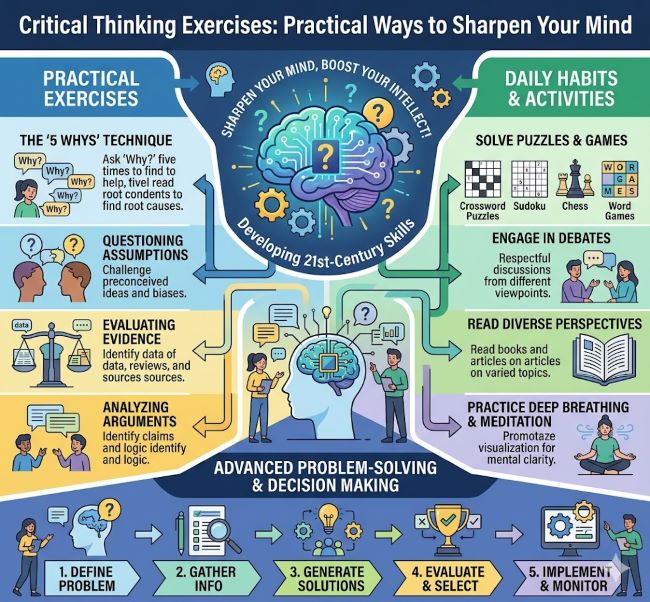
Now to the heart of the matter. These critical thinking exercises turn the principles above into concrete practice, and you can weave them into an ordinary day without any special tools.
The Five Whys. When you face a problem, ask why it happened, then ask why again about that answer, five times in total. This simple drill pushes past surface symptoms to root causes and is one of the most useful critical thinking exercises for problem solving. A late project, traced through five whys, often reveals a process flaw rather than a lazy person.
Argue the opposite side. Take a belief you hold and build the strongest possible case against it. Playing devil’s advocate with yourself forces you to understand other perspectives and exposes the weak points in your own reasoning. Among these drills, this one is especially good at curing overconfidence.
Evaluate a news story. Pick an article and analyze it like a detective. Who wrote it, what evidence backs the claims, what might be missing, and does the headline match the content? Doing this regularly is one of the sharpest drills for resisting misinformation.
Question your daily decisions. Once a day, pick a choice you made automatically and ask what assumptions drove it. This turns routine moments into practice that builds self-awareness about how you actually decide things.
Solve logic puzzles and brain teasers. Riddles, Sudoku, and logic grids exercise the analytical muscles directly in a low-stakes, even fun way. They are gentle drills that keep reasoning sharp between bigger challenges.
Steelman before you argue. Before disagreeing with someone, restate their position so well that they would agree with your summary. This habit, the opposite of a straw man, forces genuine understanding and makes any later critique far stronger.
Keep a decision journal. Write down important decisions, the reasoning behind them, and what you expect to happen. Reviewing it later shows you where your thinking was sound and where it went wrong, turning experience into a feedback loop. This is one of the most powerful drills for long-term growth because it makes your reasoning visible.
Mixing several of these drills into your week keeps the practice varied and engaging, which is the surest way to stick with it.
The Best Ways to Enhance Critical Thinking Daily
Beyond specific drills, certain habits steadily build the skill in the background. These are the best ways to enhance critical thinking without setting aside dedicated study time, since they fold into things you already do.
Reading widely tops the list. Exposure to different subjects, authors, and viewpoints stretches your thinking and supplies the raw material for better reasoning, so reading broadly is among the most reliable ways to grow over a lifetime. Conversation matters too. Discussing ideas with people who think differently, and listening genuinely rather than waiting to talk, sharpens your reasoning through friendly friction.
Curiosity is the engine behind it all. Asking questions, wondering how things work, and refusing to accept easy answers keeps the mind active and engaged. Writing is another quiet powerhouse, because putting thoughts into clear sentences forces you to organize and test them, which is why journaling and explaining ideas to others helps so much. Finally, embrace being wrong. Treating mistakes as information rather than failures keeps you open to better ideas, and that openness is itself one of the most valuable habits that exists. Together, these habits turn everyday life into a continuous, low-effort training ground.
Common Barriers to Clear Thinking
Even with good intentions, several mental traps quietly undermine reasoning. Knowing them is half the battle, since a named trap is far easier to avoid.
Confirmation bias leads us to favor information that supports what we already believe while dismissing what does not. The fix is to deliberately seek out opposing views. Emotional reasoning lets feelings override facts, especially on topics we care about, so it helps to notice when emotion is steering a conclusion. The bandwagon effect pushes us to believe something simply because many others do, when popularity is no proof of truth.
Other barriers include overconfidence, where we trust our own judgment more than the evidence warrants, and the comfort of snap judgments that feel right but skip careful analysis. Mental shortcuts are useful for trivial choices but dangerous for important ones. Simply slowing down on decisions that matter defeats most of these traps. Awareness is the key, because you cannot correct a bias you do not notice, and spotting these patterns in your own thinking is itself a powerful exercise.
Building a Lasting Habit
The final piece is consistency. Like physical fitness, reasoning ability fades without regular use and grows with steady practice, so the goal is a sustainable routine rather than a burst of intense effort.
Start small by choosing one or two practices and doing them regularly rather than attempting everything at once. Build them into existing routines, such as questioning one news story over morning coffee or running a quick five whys when a problem appears at work. Track your progress with a simple journal, which both reinforces the habit and shows how far you have come. Be patient, since meaningful improvement takes weeks and months, not days, and the gains are cumulative.
Above all, stay curious and keep the practice light. The aim is not to become a relentless skeptic who doubts everyone, but a clear, fair thinker who reasons well and stays open to truth. Make these habits a normal part of how you move through the world, and sharper thinking stops being an effort and becomes simply who you are.
Frequently Asked Questions
Can critical thinking really be learned? Yes. It is a skill, not a fixed trait, and it improves with deliberate practice just like any other ability.
How long does it take to improve? Expect gradual progress over weeks and months. Small, consistent practice beats occasional intense effort, and the gains build steadily over time.
What is the single best exercise to start with? The five whys is a great entry point because it is simple, works on real problems, and quickly shows the value of digging past the obvious answer.
Is critical thinking the same as being negative? No. It means reasoning fairly and questioning claims, not doubting everything or being cynical. A good critical thinker stays open-minded.
Do brain teasers actually help? They help keep analytical skills sharp in a fun, low-stakes way, though they work best alongside real-world practice like evaluating arguments and decisions.
How do I use these skills at work? Apply them by questioning assumptions in meetings, weighing evidence before decisions, and considering alternative explanations rather than settling on the first one.
Key Takeaways
- Critical thinking exercises train your mind to analyze information, question assumptions, and reason clearly, and they work because the skill grows with practice.
- Critical thinking is the disciplined habit of weighing evidence and reaching fair, reasoned judgments rather than emotional or automatic ones.
- Clear critical thinking examples appear everywhere, from questioning a health headline to comparing prices instead of trusting a sales pitch.
- For how to improve critical thinking, question your assumptions, weigh the quality of evidence, seek out opposing views, and slow down before concluding.
- Practical critical thinking exercises include the five whys, arguing the opposite side, evaluating news stories, questioning daily decisions, logic puzzles, steelmanning, and keeping a decision journal.
- The best ways to enhance critical thinking day to day are reading widely, talking with people who think differently, staying curious, writing to clarify ideas, and being willing to be wrong.
- Common barriers like confirmation bias, emotional reasoning, the bandwagon effect, and overconfidence undermine clear thinking, and awareness is the main defense.
- Consistency is everything, so start with one or two critical thinking exercises, build them into your routine, and track your progress with a journal.
- The goal is not to be a relentless skeptic but a fair, clear thinker who reasons well and stays open to better information.
- With steady practice, sharper reasoning shifts from being an effort to simply becoming part of how you think.