How to Check Tire Pressure: A Simple Step-by-Step Guide
It is one of the simplest pieces of car maintenance, yet most people skip it until a warning light appears or a tire looks low. Learning how to check tire pressure takes about five minutes, costs almost nothing, and pays you back in safety, better fuel economy, and tires that last longer. Underinflated tires drag down your mileage and wear out fast, while overinflated ones ride rough and grip poorly. Getting the number right is the whole game.
This guide walks through exactly how to check tire pressure, what your target numbers should be, which tools to use, and where to find air when you need to top off. By the end, this small habit will feel like second nature.
Why Tire Pressure Matters
Before the how-to, it helps to know why this small task matters so much. Proper tire pressure affects safety, cost, and comfort all at once, which is why it is worth a few minutes of attention.
Correctly inflated tires grip the road the way they were designed to, which keeps braking, cornering, and handling predictable. Low pressure makes a car feel sluggish, lengthens stopping distances, and raises the risk of a blowout from overheating. It also burns more fuel, since soft tires create more rolling resistance, and it wears the edges of the tread prematurely. Overinflation causes its own problems, with a harsh ride and faster wear down the center of the tread.
The payoff for keeping the right pressure is real money and real safety. You get better gas mileage, longer tire life, and a car that handles the way it should. That is a strong return for a task that takes five minutes a month, and it is exactly why learning the habit is worthwhile.
What Should Your Numbers Be?
The most common question is what the number should actually be. So what should my tire pressure be? The answer is whatever your vehicle’s manufacturer recommends, not the number printed on the tire itself.
Here is the key distinction. The number molded into the tire’s sidewall is the maximum pressure the tire can hold, not the recommended one. To find what should tire pressure be for your car, look at the sticker inside the driver’s side door jamb, or check the owner’s manual. That sticker lists the recommended tire psi for your specific vehicle, and it is the number you should aim for.
For most passenger cars, normal tire pressure falls between 30 and 35 psi, though it varies by vehicle, so always trust your door sticker over a general range. When people ask what psi should my tires be, the honest answer is that it depends on the car, and the door jamb has the exact figure. Front and rear tires sometimes call for different pressures, and a heavily loaded vehicle may need more, so check both numbers on the sticker. Knowing what should my tire pressure be for your own car, rather than guessing, is the foundation of doing this right, and confirming what should tire pressure be takes only a glance at that label.
The Tools You Need
Checking your numbers requires one simple tool. A tire gauge is an inexpensive device that reads the pressure inside your tires, and every driver should keep one in the glove box.
There are a few types of tire gauge to choose from. The classic stick or pencil gauge is cheap and pocket-sized, sliding out a marked bar to show the reading. A dial gauge has a round face that is easy to read. A digital tire pressure gauge shows the number on a screen and is often the most accurate and beginner-friendly. Any of them works, so pick whichever you find easiest to read. A good gauge costs only a few dollars and lasts for years.
When buying a tire air pressure gauge, look for one that reads in the range your car needs and feels solid rather than flimsy. A quality tire air pressure gauge gives consistent readings you can trust, while a cheap, worn one can be off by several psi. Many gas station air pumps have a built-in gauge too, but those are often inaccurate from heavy use, so your own gauge is the more reliable choice. Keeping a dependable gauge in the car means you can check anytime, anywhere.
How to Check Tire Pressure Step by Step
Now for the main event. Knowing how to check tire pressure is a quick, repeatable routine once you have done it once. Here are the steps.
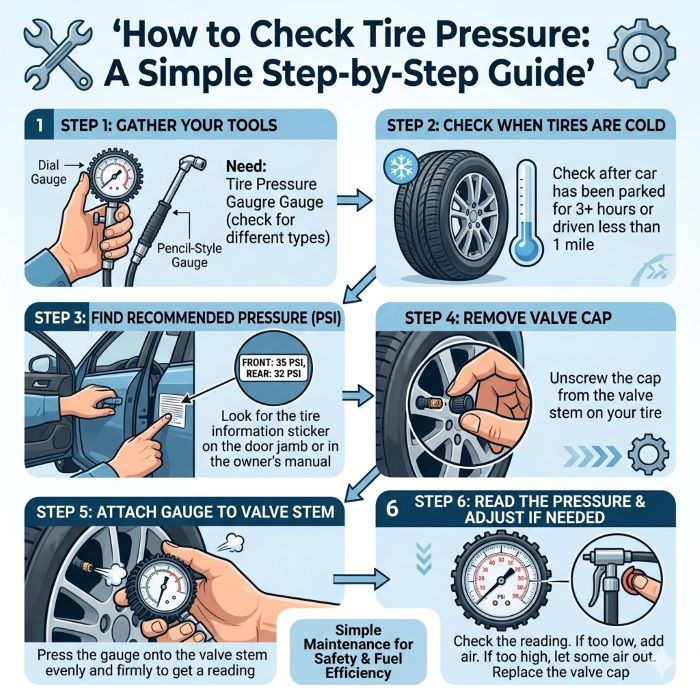
- Check when the tires are cold, meaning the car has sat for at least three hours or been driven less than a mile. Driving heats the tires and raises the reading, throwing off accuracy.
- Find your recommended pressure on the door jamb sticker or in the manual.
- Unscrew the valve cap on the first tire and keep it somewhere safe.
- Press your gauge firmly onto the valve stem until the hissing stops and you get a steady reading.
- Compare the reading to your recommended number.
- Add air if it is low or release a little if it is high, then recheck.
- Replace the valve cap and repeat for all four tires, plus the spare if you have one.
That is the entire process. The cold-tire rule is the part people most often get wrong, so make a habit of checking in the morning before driving. Once you learn how to check tire pressure this way, the whole routine takes about five minutes. Doing it correctly every time is simply a matter of following these steps, and how to check tire pressure stops being a mystery the moment you have done it once.
Where to Add Air to Your Tires
Once you know a tire is low, you need a source of air. The most common place is a gas station, many of which have an air pump near the edge of the lot. If you are searching for tire air near me, a quick map search turns up nearby gas stations and service centers with air machines.
Some of these cost a dollar or two in quarters, while others are free, especially at full-service stations and some tire shops. Hunting for free air for tires is worth it, since several states require stations to offer free air to paying customers, and many tire retailers provide it as a courtesy. When you look up tire air near me, the listings and reviews often mention whether the air is free, which saves you a trip with no quarters. Searching specifically for free air for tires can point you to the stations that do not charge.
You can also buy a small portable air compressor that plugs into your car, which lets you inflate tires at home or on the road without hunting for a pump. For drivers who check often, that convenience is worth the modest cost. However you do it, add air in small bursts and recheck with your gauge between each, since it is easier to add a little more than to let air back out.
How Often and Other Tips
A good rule is to check your pressure about once a month and before any long road trip. Tires naturally lose a little air over time, roughly one psi a month, and faster in cold weather, so monthly checks catch slow leaks before they become problems.
Temperature has a big effect worth knowing. Pressure drops about one psi for every ten-degree fall in temperature, which is why low-pressure warnings often appear on the first cold morning of the season. That does not always mean a leak, just cold air, so check and top off as needed. Do not forget the spare tire, which is useless in an emergency if it is flat. And if a tire repeatedly reads low, have it inspected for a slow leak or a failing valve rather than just refilling it again and again.
One more tip: the low-pressure warning light on your dashboard is a backup, not a substitute for checking. It usually only triggers once pressure is significantly low, well below ideal, so regular manual checks keep your tires in the healthy range long before the light ever comes on.
Signs Your Tires Need Attention
Even between monthly checks, your car often tells you when something is off. A few warning signs are worth watching for so you can catch trouble early.
Watch for a ride that suddenly feels softer, mushier, or less responsive than usual, which can mean a tire is losing air. Uneven tread wear is another clue, with worn edges pointing to chronic underinflation and a worn center pointing to overinflation. A car that pulls to one side, or a tire that visibly looks lower than the others, both call for a quick check with your gauge. And rising fuel costs with no other explanation can trace back to soft tires dragging down your mileage.
If you notice any of these, measure all four tires and inflate to the recommended number. When a tire keeps going low despite topping off, have a shop look for a slow leak, a nail, or a bad valve, since a persistent drop rarely fixes itself.
Frequently Asked Questions
How often should I check my tires? About once a month and before long trips. Tires lose air gradually, so monthly checks catch problems early.
Should I use the number on the tire? No. That is the maximum pressure, not the recommended one. Use the figure on the door jamb sticker or in your owner’s manual.
Why check when tires are cold? Driving heats tires and temporarily raises the pressure, so a cold reading is the accurate one. Check before driving or after the car has sat for a few hours.
What if my pressure is a little high? Release a small amount of air by pressing the valve pin, then recheck. A couple of psi over is minor, but matching the recommended number is best.
Does cold weather really lower pressure? Yes. Pressure falls about one psi per ten-degree temperature drop, which is why warnings often appear on cold mornings even without a leak.
Is the dashboard warning light enough? No. It usually triggers only when pressure is already quite low, so regular manual checks keep tires healthier than relying on the light alone.
Key Takeaways
- Learning how to check tire pressure takes about five minutes a month and improves safety, fuel economy, and tire life.
- Proper tire pressure keeps handling and braking predictable, while low pressure wastes fuel and risks a blowout and overinflation causes a harsh ride.
- For what should my tire pressure be, use your vehicle’s recommended number from the door jamb sticker, not the maximum printed on the tire.
- Most cars have normal tire pressure between 30 and 35 psi, but the exact tire psi varies, so the sticker answers what psi should my tires be and what should tire pressure be for your car.
- A tire gauge is essential, and a digital tire pressure gauge is often the easiest to read, while a quality tire air pressure gauge gives readings you can trust.
- To check, measure cold tires with your gauge, compare to the recommended number, and add or release air until they match, then recap all four and the spare.
- When you need air, search tire air near me for nearby pumps, and look for free air for tires, which many stations and tire shops offer.
- Check pressure monthly and before trips, remember that cold weather lowers it about one psi per ten degrees, and do not neglect the spare.
- A dashboard warning light is only a backup, since it triggers when pressure is already low, so manual checks keep tires in the healthy range first.
- Keeping a reliable tire pressure gauge in the car makes the whole habit easy, turning how to check tire pressure into a quick routine.