Cognitive Learning Theories: A Complete Guide to How the Mind Learns
For a long time, the dominant view of learning treated the mind like a black box. You put a stimulus in, you got a behavior out, and what happened in between did not much matter. Cognitive learning theories rejected that idea. They argue that what happens inside the mind, the thinking, remembering, organizing, and problem-solving, is the whole point. Learning is not just a change in behavior. It is a change in what a person knows and how they think.
This shift reshaped education, psychology, and the design of everything from classrooms to apps. If you want to understand how people genuinely learn, rather than just how they respond, this is where the real answers live. This guide walks through what these theories claim, the major thinkers who built them, the memory science underneath them, how they shape teaching and training, and where they fall short.
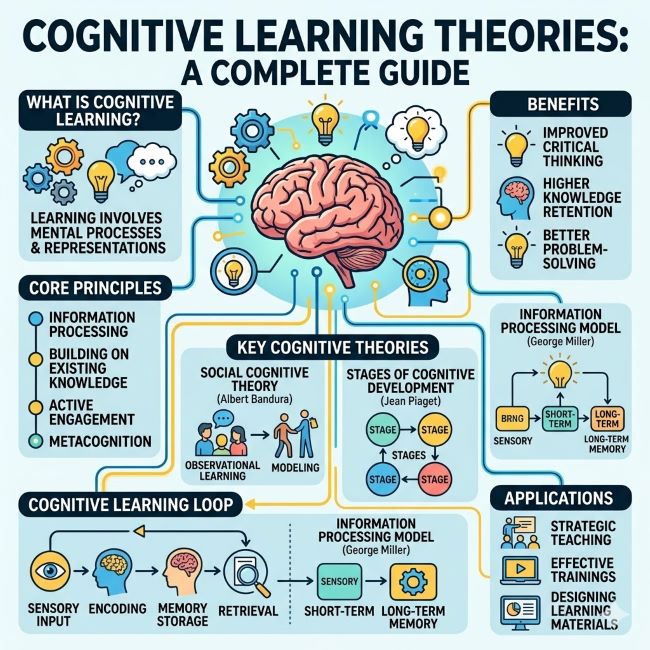
What Cognitive Learning Theory Means
Cognitive learning theory focuses on the mental processes involved in acquiring knowledge. Instead of asking only what a learner does, it asks what a learner thinks. It treats the brain as an active processor of information, not a passive receiver of rewards and punishments.
This stands in contrast to behaviorism, which explained learning purely through observable responses to stimuli. Behaviorism is not wrong about everything. Habits and reflexes follow its rules well, and reinforcement clearly shapes behavior. But it struggles to explain how someone solves a brand-new problem, grasps an abstract concept, or reorganizes their entire understanding after a single moment of insight. Cognitive learning theories fill that gap by looking at attention, memory, perception, reasoning, and the way knowledge gets structured in the mind.
The core claim is simple. Learning depends on internal mental activity, so if you want better learning, you have to understand and support those mental processes. A learner is not an empty vessel being filled. They are an active builder, constantly interpreting new information through the lens of what they already know.
The Cognitive Revolution
These theories did not appear out of nowhere. They grew out of what historians of psychology call the cognitive revolution, a shift that gathered momentum through the 1950s and 1960s. Several forces pushed it forward at once.
The rise of computers gave psychologists a powerful new metaphor. If a machine could take in information, store it, process it, and produce output, perhaps the human mind worked in a comparable way. Around the same time, linguists argued that the richness of human language could not be explained by simple stimulus-response chains, since children produce sentences they have never heard before. Researchers studying memory, attention, and problem-solving kept running into mental phenomena that behaviorism simply could not describe.
The result was a turn inward. Psychology began treating the mind itself as a legitimate object of study, and the cognitive approach became the framework for explaining how that mind acquires and uses knowledge. This historical context matters because it explains why so many of these theories borrow the language of information, processing, and storage.
Piaget and Cognitive Development
Jean Piaget gave us one of the foundational cognitive learning theories with his work on cognitive development. He proposed that children move through distinct stages of thinking, each with its own logic and limits. A young child does not just know less than an older one. They reason in a fundamentally different way.
Piaget described four stages. In the sensorimotor stage, from birth to about age two, infants learn through senses and movement and gradually develop object permanence, the understanding that things continue to exist when out of sight. In the preoperational stage, from about two to seven, children use language and symbols but struggle with logic and tend to see the world from their own viewpoint. In the concrete operational stage, from about seven to eleven, children reason logically about concrete situations and grasp ideas like conservation, that the amount of water stays the same when poured into a different glass. In the formal operational stage, from around twelve onward, adolescents handle abstract, hypothetical, and systematic reasoning.
Two ideas from Piaget remain central to learning. Assimilation is when we fit new information into what we already know. Accommodation is when we change our existing mental structures to make room for information that does not fit. A child who calls every four-legged animal a dog is assimilating. When they learn that some of those animals are cats and adjust their categories, they are accommodating. Learning, in this view, is a constant balancing act between the two, driven by the mind’s push toward equilibrium, a stable fit between what we expect and what we encounter.
Piaget’s stages have been refined and criticized over the years, with later researchers showing children often develop specific abilities earlier than he claimed. But his central insight, that learners actively construct knowledge rather than passively absorb it, became a cornerstone of modern education.
Vygotsky and Sociocultural Theory
Lev Vygotsky added a crucial dimension that Piaget underplayed: the social world. His sociocultural theory argues that learning is deeply shaped by interaction with other people and the surrounding culture. We do not build knowledge alone. We build it with parents, teachers, peers, and the tools and language our culture provides.
His most famous contribution is the Zone of Proximal Development, the gap between what a learner can do alone and what they can do with guidance. Inside this zone sit the skills a learner is ready to develop but cannot yet manage independently. A skilled helper, through a process often called scaffolding, supports the learner just enough to bridge that gap. As the learner grows more capable, the support is gradually removed, much like scaffolding comes down once a building can stand on its own. This is why a good teacher or mentor can accelerate learning far beyond what someone would manage in isolation.
Vygotsky also stressed the role of language as a tool for thought. He argued that the private speech children use while working through a task, talking themselves through a puzzle, for example, eventually becomes internal thinking. Language, in his view, is not just for communication. It is the medium through which higher mental functions develop. Among these theories, his work is the strongest reminder that the mind is shaped by its social and cultural environment, not just its internal machinery.
The Information Processing Model
Among cognitive learning theories, the information processing model borrows most directly from how computers handle data. It describes the mind as a system that takes in input, processes it, stores it, and retrieves it when needed.
The model usually outlines three components of memory. Sensory memory briefly holds incoming sensory information for a fraction of a second, just long enough for the mind to decide what deserves attention. Working memory, sometimes called short-term memory, holds and actively manipulates a small amount of information at once, typically for only seconds unless we keep rehearsing it. Long-term memory stores knowledge over extended periods, in theory without limit.
Several processes move information through this system. Attention determines what gets into working memory in the first place, filtering out the flood of input we ignore every moment. Encoding transforms information into a form that can be stored, and meaningful encoding, connecting new material to existing knowledge, produces far stronger memories than rote repetition. Retrieval is the act of pulling stored information back into working memory, and the ease of retrieval depends heavily on how well the information was encoded and how often it has been practiced.
The practical insight here is that working memory is a bottleneck. It can only handle a handful of items at once. Information that gets rehearsed and meaningfully connected moves into long-term memory, while information that does not gets lost within seconds. Effective learning, then, is partly about moving knowledge across these stages without overwhelming the limited working memory along the way.
Schema Theory
Schema theory explains how knowledge gets organized in long-term memory. A schema is a mental framework that groups related information together. You have a schema for what a restaurant is, for example, which includes menus, ordering, eating, and paying. When you walk into a new restaurant, that schema tells you what to expect and how to behave, even if you have never been there before.
Schemas make learning efficient in two ways. They help us interpret new situations quickly by supplying expectations, and they give new information somewhere to attach. New material that connects to an existing schema is far easier to understand and remember than isolated facts floating with no anchor. This is why relating new content to what a learner already knows is one of the most reliable teaching strategies in the entire field.
Schemas also explain certain errors. Because they shape what we expect, they can lead us to remember things that fit the schema even when they did not happen, or to overlook details that contradict it. A learner with a flawed schema may confidently misunderstand new information, which is why surfacing and correcting prior misconceptions is so important. Building accurate, well-connected schemas is, in many ways, what deep learning actually is.
Cognitive Load Theory
Building on the information processing model, John Sweller developed cognitive load theory, one of the most practically useful cognitive learning theories for instruction. It centers on the limits of working memory and how teaching can either respect or overload those limits.
The theory identifies three types of cognitive load. Intrinsic load comes from the inherent difficulty of the material itself, since some concepts simply have many interacting parts. Extraneous load comes from the way information is presented, including poor design, confusing instructions, and distractions that add mental effort without adding understanding. Germane load is the productive mental effort that goes into building and automating new schemas, the kind of effort you actually want.
The goal is to reduce extraneous load so that working memory has room for the load that matters. Cluttered slides, split attention between a diagram and a separate caption, and irrelevant detail all waste limited mental capacity. Clean design, worked examples that show a full solution before asking learners to try one, and breaking complex material into manageable chunks all help learners spend their working memory where it counts. As learners build expertise, they can handle more, because well-formed schemas let them treat many small pieces as a single chunk, a phenomenon that explains how experts seem to grasp complex problems at a glance.
Social Cognitive Theory
Albert Bandura’s social cognitive theory bridges cognitive and social ideas. It argues that people learn a great deal by observing others, a process called observational learning or modeling. We watch what others do, see the consequences they experience, and adjust our own behavior accordingly, all without direct trial and error ourselves. Bandura’s famous Bobo doll experiments showed children imitating aggressive behavior they had merely watched, demonstrating that learning can happen through observation alone.
Bandura also emphasized self-efficacy, a person’s belief in their own ability to succeed at a specific task. This belief strongly influences motivation, effort, and persistence. A learner who believes they can improve will attempt harder challenges, persist through difficulty, and recover faster from setbacks than one who doubts themselves. Self-efficacy is built through past successes, watching similar people succeed, encouragement from others, and managing the stress that surrounds a task.
A third key idea is reciprocal determinism, the notion that a person’s behavior, their personal factors like thoughts and beliefs, and their environment all continuously influence one another. Among these theories, Bandura’s work captures most clearly how thinking, action, and surroundings form a feedback loop rather than a one-way street.
Constructivism and Metacognition
Two further ideas extend the cognitive tradition in important ways. Constructivism, which draws on both Piaget and Vygotsky, holds that learners actively construct their own understanding rather than receiving it ready-made. Knowledge is built through experience, reflection, and the steady revision of existing ideas. In a constructivist classroom, the teacher acts less as a lecturer pouring in facts and more as a guide who designs experiences that prompt learners to think, test, and build understanding for themselves.
Metacognition adds another layer: thinking about your own thinking. It covers a learner’s awareness of how they learn and their ability to plan, monitor, and adjust their own strategies. A student who notices they do not understand a passage and chooses to reread it, or who realizes that self-testing helps more than rereading, is using metacognition. Research consistently shows that strong metacognitive skills predict better learning, because they let people direct their own mental effort wisely. Teaching learners to plan, check their understanding, and reflect on what works turns them into more independent and effective learners over time.
How These Theories Shape Teaching
Cognitive learning theories are not just academic. They drive real classroom and training practice. Teachers connect new lessons to prior knowledge to build on existing schemas. They break content into smaller pieces to respect working memory limits. They use scaffolding to support learners within their Zone of Proximal Development, then fade that support as competence grows.
These theories also support active learning over passive reception. Because learning depends on mental processing, methods that force learners to think, such as questioning, problem-solving, and explaining ideas in their own words, produce deeper understanding than simply listening or rereading. Two strategies stand out as especially well supported. Retrieval practice, where learners recall information rather than just review it, strengthens long-term memory far more than passive review. Spaced practice, spreading study over time instead of cramming, takes advantage of how memory consolidates and resists forgetting. Both follow directly from what the memory models predict.
Worked examples, clear visuals paired with explanation, and the gradual release of responsibility from teacher to student all trace back to these theories as well. Good instruction, in this light, is essentially the art of managing a learner’s limited attention and working memory while helping them build accurate, lasting schemas.
Applications Beyond the Classroom
The reach of these theories extends well past schools. In the workplace, training programs use chunking, scaffolding, and spaced practice to help employees build skills that stick. Instructional designers who build online courses lean heavily on cognitive load theory, stripping away clutter and pacing content so learners are not overwhelmed.
Educational technology applies these ideas at scale. Apps that space out review, quiz users to force retrieval, and adapt difficulty to keep learners in their zone of proximal development are translating decades of cognitive research into software. User interface design borrows the same principles, since a well-designed screen reduces extraneous load and lets people focus on the task. Even fields like healthcare and aviation use these theories to design training and checklists that account for the real limits of human attention and memory under pressure.
Criticisms and Limitations
No framework is complete, and cognitive learning theories have real limits worth acknowledging. By focusing on internal mental processes, some versions underplay the role of emotion, motivation, and physical context, all of which shape learning powerfully. The computer metaphor at the heart of the information processing model is useful but imperfect, since human minds are not literal machines and do not process information in neat, sequential steps.
Critics also note that some theories are hard to test directly, because mental processes cannot be observed the way behavior can. Piaget’s rigid stages have been challenged by evidence that development is more continuous and variable than he proposed. And cultural critics point out that several theories were built largely in Western contexts and may not capture how learning works across all cultures. The strongest modern approaches tend to combine insights from several of these theories rather than relying on any single one, while also drawing on emotional and social factors that the purely cognitive view can miss.
Key Takeaways
- Cognitive learning theories explain learning as a change in knowledge and thinking, focusing on internal mental processes rather than only observable behavior.
- They emerged from the cognitive revolution of the 1950s and 1960s as a response to behaviorism, which could not fully explain understanding, problem-solving, or insight.
- Piaget’s cognitive development theory describes four stages of thinking and the processes of assimilation and accommodation that drive learning toward equilibrium.
- Vygotsky’s sociocultural theory emphasizes social interaction, the Zone of Proximal Development, scaffolding, and language as the engines of learning.
- The information processing model treats the mind like a computer, moving information through sensory, working, and long-term memory, with attention, encoding, and retrieval as key processes and working memory as the main bottleneck.
- Schema theory shows that organizing new information around existing mental frameworks makes it easier to understand and remember, while flawed schemas can cause confident misunderstanding.
- Cognitive load theory distinguishes intrinsic, extraneous, and germane load, and stresses reducing unnecessary mental burden so working memory can build real understanding.
- Bandura’s social cognitive theory highlights observational learning, the power of self-efficacy, and reciprocal determinism among behavior, thought, and environment.
- Constructivism frames learners as active builders of knowledge, while metacognition, thinking about one’s own thinking, consistently predicts stronger, more independent learning.
- In practice, cognitive learning theories support connecting new material to prior knowledge, chunking, scaffolding, retrieval practice, and spaced study, and they apply far beyond classrooms to workplace training, online learning, and interface design.
- These theories have limits too, including an underemphasis on emotion and culture and an imperfect computer metaphor, so the best modern approaches blend several of them together.