Tom Kennedy and Winston Churchill
Tom Kennedy and Winston Churchill lived in different centuries and led very different organizations. Churchill guided Britain through World War II as prime minister. Thomas A. “Tom” Kennedy, an engineer, rose through Raytheon’s radar programs to become the company’s chairman and CEO.
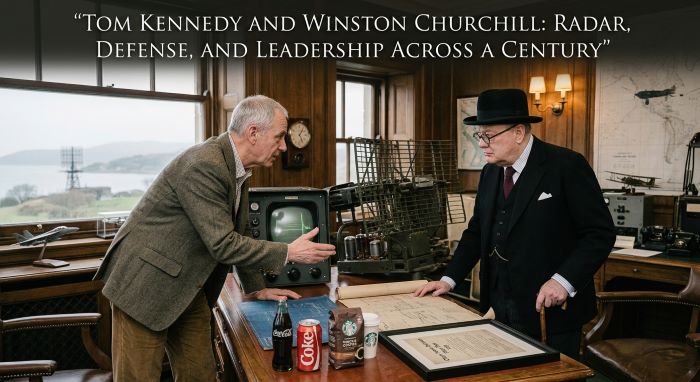
There’s no personal link between them, but radar ties their stories together. Churchill’s government backed radar as a key weapon in World War II, and Kennedy built his career on radar technology decades later. This guide compares Tom Kennedy and Winston Churchill.
Tom Kennedy and Winston Churchill at a Glance
| Detail | Tom Kennedy | Winston Churchill |
|---|---|---|
| Full name | Thomas A. Kennedy | Sir Winston Leonard Spencer Churchill |
| Born | 1955 | November 30, 1874, Blenheim Palace, England |
| Died | Living | January 24, 1965, London, at age 90 |
| Education | Rutgers (BS), Air Force Institute of Technology (MS), UCLA (PhD) | Harrow School; Royal Military College, Sandhurst |
| Best known for | Leading Raytheon | Leading Britain in World War II |
| Top role | Chairman and CEO of Raytheon; executive chairman of Raytheon Technologies | Prime Minister of the United Kingdom |
| Years in top role | CEO from 2014 to 2020 | 1940 to 1945 and 1951 to 1955 |
| Major honor | Engineering leadership awards | Nobel Prize in Literature (1953) |
Who Is Tom Kennedy?
Note: Several notable people share the name Tom Kennedy. This article focuses on Thomas A. Kennedy, the former Raytheon chief executive.
Kennedy earned a bachelor’s degree in electrical engineering from Rutgers University, a master’s from the Air Force Institute of Technology, and a doctorate in engineering from UCLA. He served in the US Air Force before joining Raytheon in 1983, where he worked in radar development.
He rose through Raytheon’s businesses, became chief operating officer in 2013, and was named CEO in March 2014. He also became chairman. In April 2020, Raytheon merged with United Technologies to form Raytheon Technologies, now RTX. Greg Hayes became CEO, and Kennedy became executive chairman before retiring from that role in 2021. He later joined the board of Textron.
Who Was Winston Churchill?
Winston Churchill was born at Blenheim Palace into an aristocratic family. He attended Harrow School and the Royal Military College, Sandhurst, then served as a soldier and war correspondent.
He entered Parliament in 1900 and held many government posts, including First Lord of the Admiralty. He became prime minister in May 1940, as Britain faced Nazi Germany. His speeches and leadership helped rally the nation. He served as prime minister again from 1951 to 1955 and won the Nobel Prize in Literature in 1953 for his historical writing and speeches.
The Radar Connection Between Tom Kennedy and Winston Churchill
Radar is the clearest thread between Tom Kennedy and Winston Churchill.
- Churchill’s war: During the Battle of Britain in 1940, a network of radar stations helped the Royal Air Force spot incoming German planes. Churchill’s government strongly supported this technology.
- The magnetron: In 1940, British scientists shared the cavity magnetron, a key radar component, with the United States. Raytheon became a major producer of magnetrons during the war.
- Kennedy’s career: Decades later, Kennedy began his Raytheon career in radar development and led a company that still builds advanced radar systems.
Career Comparison
| Area | Tom Kennedy | Winston Churchill |
|---|---|---|
| Field | Engineering and defense business | Politics, military, and writing |
| Path to the top | Rose through engineering and management | Rose through Parliament and cabinet posts |
| Biggest challenge | Merging Raytheon with United Technologies | Leading Britain against Nazi Germany |
| Communication style | Technical and business focused | Famous speeches and writing |
Leadership Styles
Churchill was known for bold speeches, stubborn determination, and a talent for inspiring people in dark times. Kennedy was known as an engineer CEO who focused on technology, operations, and growth in defense programs. Both led organizations through high stakes periods.
Similarities
- Military ties: Churchill served as a soldier, and Kennedy served in the Air Force.
- Defense focus: Both spent their careers deeply involved in national security.
- Technology support: Churchill backed radar, and Kennedy built radar systems.
Differences
| Area | Tom Kennedy | Winston Churchill |
|---|---|---|
| Background | Engineer from a middle class American path | British aristocrat |
| Public fame | Known mainly in business | One of the most famous leaders in history |
| Writing | Business and technical focus | Nobel winning author |
Fun Facts
- Churchill was also a talented painter.
- Raytheon is linked to the invention of the microwave oven, which grew out of radar research.
- Churchill was made an honorary US citizen in 1963.
- Kennedy holds a doctorate in engineering from UCLA.
Early Lives in Detail
Churchill’s childhood was lonely. His father, Lord Randolph Churchill, was a leading politician who paid him little attention, and his American born mother, Jennie Jerome, was often away. He struggled at school but loved history and the English language. After three tries, he entered Sandhurst and graduated in 1894 as a cavalry officer.
He then saw action in Cuba, India, Sudan, and South Africa. During the Boer War, he was captured and escaped from a prisoner of war camp, a story that made him famous back home and helped launch his political career.
Kennedy’s path was quieter but steady. He studied electrical engineering at Rutgers and then served as an officer in the US Air Force, where he worked on technical programs. The Air Force sent him to graduate school, and he later completed a doctorate at UCLA. When he joined Raytheon in 1983, he brought both military experience and deep technical training.
Big Decisions Each Leader Made
Churchill made many hard calls. In 1940, he refused to seek peace terms with Hitler even when Britain stood almost alone. He built a close alliance with US President Franklin Roosevelt and later worked with the Soviet Union against Germany. Not all of his choices were wise. Historians still debate the Gallipoli campaign in World War I and his views on the British Empire and India.
Kennedy’s big calls came in business. As CEO, he pushed Raytheon to grow its missile defense, cyber, and international sales. His largest move was the merger with United Technologies, announced in 2019. The deal joined Raytheon’s defense systems with jet engines from Pratt and Whitney and aircraft parts from Collins Aerospace, creating one of the largest aerospace and defense companies in the world.
Lessons From Their Careers
- Bet on technology. Churchill backed radar early, and Kennedy built a career on it.
- Stay steady under pressure. Churchill held firm in 1940, and Kennedy guided a huge merger as the pandemic began in 2020.
- Communicate clearly. Churchill’s speeches rallied a nation, while Kennedy had to explain complex defense programs to investors and the government.
- Learn from setbacks. Churchill lost elections and made mistakes but came back stronger.
Where Their Legacies Stand in 2026
Churchill remains one of the most studied leaders in history. His speeches are quoted around the world, and his former home, Chartwell, draws many visitors each year. Kennedy is remembered in the defense industry as the engineer who helped shape modern RTX. RTX continues to build Patriot missile defense systems and advanced radars, the same kind of work Kennedy started on in 1983.
Timeline at a Glance
| Year | Event |
|---|---|
| 1874 | Churchill is born at Blenheim Palace |
| 1900 | Churchill enters Parliament |
| 1940 | Churchill becomes prime minister; radar helps win the Battle of Britain |
| 1953 | Churchill wins the Nobel Prize in Literature |
| 1955 | Kennedy is born; Churchill steps down as prime minister |
| 1965 | Churchill dies in London at 90 |
| 1983 | Kennedy joins Raytheon |
| 2014 | Kennedy becomes Raytheon CEO |
| 2020 | Raytheon merges with United Technologies |
| 2021 | Kennedy retires as executive chairman |
The timeline shows a neat overlap. Kennedy was born in the same year Churchill left Downing Street for the last time.
How to Learn More
To learn more about Churchill, start with his own six volume history, The Second World War, or a modern biography such as Andrew Roberts’s Churchill: Walking with Destiny. The Churchill War Rooms museum in London shows the underground bunker where he led the war. For Kennedy, the best sources are Raytheon and RTX press releases, company annual reports, and interviews he gave to business and defense publications during his time as CEO. Books on the history of radar, such as The Invention That Changed the World by Robert Buderi, explain how British and American scientists worked together during World War II.
Frequently Asked Questions
Which Tom Kennedy is this? This article covers Thomas A. Kennedy, the former chairman and CEO of Raytheon.
Is there a link between Tom Kennedy and Winston Churchill? Not a personal one. But both are connected to the history of radar.
When was Churchill prime minister? From 1940 to 1945 and again from 1951 to 1955.
When was Kennedy Raytheon’s CEO? From 2014 until the 2020 merger that created Raytheon Technologies.
Final Thoughts
Tom Kennedy and Winston Churchill led in very different worlds, but both understood how technology shapes national security. Churchill’s support for radar helped win a war, and Kennedy’s engineering career helped build the next generation of defense systems.
Key Takeaways
- Tom Kennedy and Winston Churchill are linked by the history of radar, not by a personal relationship.
- Kennedy joined Raytheon in 1983 in radar development and became CEO in 2014.
- Churchill led Britain in World War II and won the Nobel Prize in Literature in 1953.
- Raytheon produced radar magnetrons in World War II after Britain shared the technology.
- Tom Kennedy and Winston Churchill both had military ties and focused on national defense.
- Kennedy became executive chairman of Raytheon Technologies after the 2020 merger.