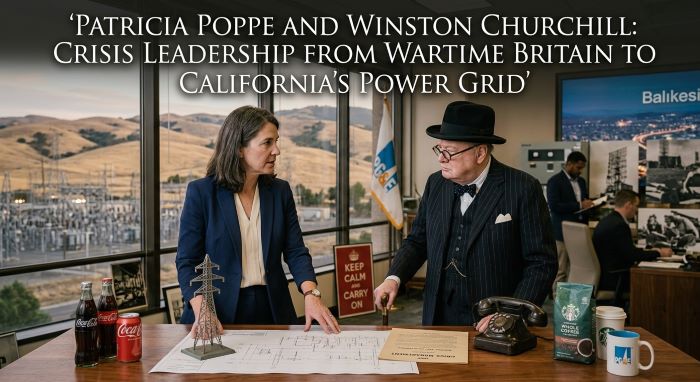
Patricia Poppe and Winston Churchill
Patricia Poppe and Winston Churchill led in very different times and places. Churchill guided Britain through World War II as prime minister. Poppe leads PG&E, one of the largest utilities in the United States, through wildfire risk, rebuilding, and the shift to clean energy.
There’s no personal link between them. But energy connects their stories. As head of the Royal Navy before World War I, Churchill made a famous decision to switch British warships from coal to oil. Over a century later, Poppe is helping lead a major energy shift of her own. This guide compares Patricia Poppe and Winston Churchill.
Patricia Poppe and Winston Churchill at a Glance
| Detail | Patricia Poppe | Winston Churchill |
|---|---|---|
| Full name | Patricia K. Poppe | Sir Winston Leonard Spencer Churchill |
| Born | Michigan (exact birth date not widely published) | November 30, 1874, Blenheim Palace, England |
| Died | Living | January 24, 1965, London, at age 90 |
| Education | GMI Engineering and Management Institute, now Kettering University (BS in industrial engineering); Harvard Business School (MBA) | Harrow School; Royal Military College, Sandhurst |
| Known for | Leading CMS Energy and PG&E | Leading Britain in World War II |
| Top role | CEO of PG&E Corporation | Prime Minister of the United Kingdom |
| Years in top role | PG&E CEO since January 2021 | 1940 to 1945 and 1951 to 1955 |
| Major honor | Ranked among top women in business | Nobel Prize in Literature (1953) |
Who Is Patricia Poppe?
Patricia Poppe grew up in Michigan and earned a degree in industrial engineering from GMI Engineering and Management Institute, now called Kettering University. She later earned an MBA from Harvard Business School. She began her career in the auto industry at General Motors, working in manufacturing.
She later moved into energy. She worked at DTE Energy and then joined CMS Energy, the parent of Consumers Energy in Michigan, in 2011. She became CMS Energy’s CEO in 2016, making her one of the first women to lead a major US utility.
In January 2021, she became CEO of PG&E Corporation, the parent of Pacific Gas and Electric. She took over a company that had gone through bankruptcy after deadly California wildfires. Her plan focused on safety, including a major program to move power lines underground in high risk wildfire areas. She has also worked to improve PG&E’s finances and its relationship with customers and regulators.
Who Was Winston Churchill?
Winston Churchill was born at Blenheim Palace into an aristocratic family. He attended Harrow School and the Royal Military College, Sandhurst. He served as a soldier and war correspondent in Cuba, India, Sudan, and South Africa.
He entered Parliament in 1900 and held many posts. As First Lord of the Admiralty from 1911 to 1915, he led the Royal Navy. He became prime minister in May 1940 and led Britain through World War II. His speeches helped rally the nation during its darkest days. He served as prime minister again from 1951 to 1955 and won the Nobel Prize in Literature in 1953.
The Energy Connection Between Patricia Poppe and Winston Churchill
Energy is the clearest thread between Patricia Poppe and Winston Churchill.
- Churchill’s oil switch: In the years before World War I, Churchill pushed the Royal Navy to move from coal to oil. Oil made ships faster and easier to refuel. To secure supply, the British government bought a major stake in the Anglo Persian Oil Company, which later became BP.
- Poppe’s energy shift: At PG&E, Poppe leads a company moving toward cleaner power and safer power lines. California has set goals for carbon free electricity, and utilities like PG&E play a big role.
- Big changes, big risks: Both made decisions that reshaped energy systems and drew strong debate.
Career Comparison
| Area | Patricia Poppe | Winston Churchill |
|---|---|---|
| Field | Energy and utilities | Politics, military, writing |
| Early career | Engineer at General Motors | Soldier and war reporter |
| Biggest challenge | Rebuilding PG&E after wildfires and bankruptcy | Leading Britain against Nazi Germany |
| Key strategy | Safety, undergrounding, and customer trust | Refusing to surrender and building alliances |
Leadership Styles
Churchill was known for bold speeches, strong will, and refusing to give up. He was also known for mistakes and controversial views, which historians still debate. Poppe is known for a calm, process focused style. She often talks about “the lean operating system,” a method for improving work step by step, which she brought from her manufacturing background.
Similarities
- Crisis leaders: Churchill led during war, and Poppe took charge of a utility in crisis.
- Energy decisions: Both shaped how energy powers a nation or region.
- Long careers: Both spent decades building experience before reaching the top.
Differences
| Area | Patricia Poppe | Winston Churchill |
|---|---|---|
| Background | Engineer from Michigan | British aristocrat |
| Public fame | Known in business and energy | One of the most famous leaders in history |
| Style | Methodical, data driven | Dramatic, inspiring speeches |
| Era | 21st century | Late 19th and 20th centuries |
Timeline at a Glance
| Year | Event |
|---|---|
| 1874 | Churchill is born |
| 1911 | Churchill becomes First Lord of the Admiralty |
| 1914 | Britain buys a stake in Anglo Persian Oil |
| 1940 | Churchill becomes prime minister |
| 1953 | Churchill wins the Nobel Prize in Literature |
| 1965 | Churchill dies in London |
| 2011 | Poppe joins CMS Energy |
| 2016 | Poppe becomes CMS Energy CEO |
| 2021 | Poppe becomes PG&E CEO |
Lessons From Their Careers
- Think long term. Churchill’s oil switch shaped the navy for decades, and Poppe’s undergrounding plan is built for the long run.
- Stay steady in a crisis. Both took charge during hard times.
- Use your training. Churchill used his military past, and Poppe uses her engineering background.
- Explain your choices. Both had to win support from the public and leaders.
Where They Stand in 2026
Poppe continues to lead PG&E as it expands undergrounding, upgrades its grid, and serves millions of customers in Northern and Central California. Churchill remains one of the most studied leaders in history, and his speeches are still quoted around the world.
Fun Facts
- Churchill was also a talented painter.
- Poppe began her career working at General Motors.
- Churchill was made an honorary US citizen in 1963.
- PG&E serves about 16 million people in California.
Early Lives in Detail
Churchill’s childhood was lonely. His father, Lord Randolph Churchill, was a leading politician who paid him little attention, and his American born mother, Jennie Jerome, was often away. He struggled at school but loved history and the English language. During the Boer War, he was captured and escaped from a prisoner of war camp, which made him famous and helped launch his political career.
Poppe’s early path ran through Michigan’s auto industry. GMI, the school she attended, was linked to General Motors and used a co-op program that mixed classes with real factory work. That hands on training taught her how big operations run. She later said that factory floors shaped her focus on safety, process, and teamwork.
Big Decisions
Churchill made many tough calls. In 1940, he refused to seek peace with Hitler when Britain stood almost alone. He built a close alliance with President Franklin Roosevelt. Some choices, like the Gallipoli campaign in World War I, went badly, and historians still debate them.
Poppe’s big calls include a plan to bury about 10,000 miles of power lines in high fire risk areas. Burying lines costs more but can sharply cut wildfire risk. She has also leaned on safety shutoffs during high winds and faced pressure over rising customer bills.
Final Comparison
Churchill is a world historical figure whose choices shaped the 20th century. Poppe is a modern executive whose choices shape daily life for millions of Californians. Both faced public pressure and tough trade offs, and both showed that steady leadership matters most in hard times. Churchill had the gift of words, while Poppe relies on data, process, and clear goals to guide a company of about 28,000 workers. Each, in their own way, has left a mark on how people get their power.
Frequently Asked Questions
Is there a link between Patricia Poppe and Winston Churchill? Not a personal one. Both are linked by big decisions about energy.
When did Patricia Poppe become PG&E CEO? In January 2021.
What was Churchill’s role in energy? As First Lord of the Admiralty, he switched the Royal Navy from coal to oil.
Where did Poppe study? She studied industrial engineering at GMI, now Kettering University, and earned an MBA from Harvard.
Final Thoughts
Patricia Poppe and Winston Churchill lived in different centuries but faced a shared challenge: making big energy choices under pressure. Churchill’s oil decision changed the Royal Navy. Poppe’s work at PG&E aims to make California’s power system safer and cleaner.
Key Takeaways
- Patricia Poppe and Winston Churchill are linked by energy decisions, not by a personal relationship.
- Poppe became PG&E CEO in January 2021 after leading CMS Energy.
- Churchill switched the Royal Navy from coal to oil before World War I.
- Churchill led Britain in World War II and won the Nobel Prize in Literature in 1953.
- Patricia Poppe and Winston Churchill both led during times of crisis.
- Poppe’s plan focuses on safety and moving power lines underground.