
Shoe Molding vs Quarter Round
You’ve just installed new floors, and now there’s a thin gap between the baseboard and the floor. Maybe the floor isn’t perfectly flat, or maybe you left the required expansion gap for laminate. Either way, you need trim to cover it. Two names keep coming up: shoe molding and quarter round.
They look similar and do the same basic job. But when you compare shoe molding vs quarter round side by side, the differences in shape and style become clear. Quarter round is bulkier and rounder. Shoe molding is slimmer and taller, with a more refined look.
This guide explains how they differ, when to use each, what they cost, and how to install them like a pro.
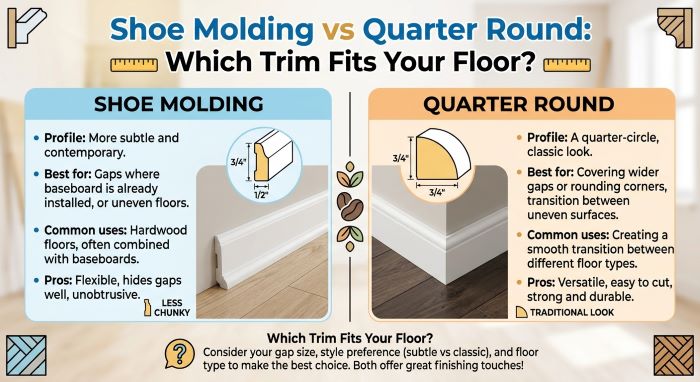
Quick Comparison
| Shoe Molding | Quarter Round | |
|---|---|---|
| Profile shape | Slim, slightly flattened curve | A true quarter of a circle |
| Common size | About 1/2 inch deep by 3/4 inch tall | About 3/4 inch by 3/4 inch |
| Look | Low profile, refined, subtle | Rounder, bulkier, more noticeable |
| Floor space it covers | Less | More |
| Best for | Modern and traditional rooms where trim should blend in | Bigger gaps and uneven floors |
| Cost | Similar, often slightly more | Similar, often slightly less |
| Flexibility | Bends a bit more easily along wavy floors | Stiffer in thicker sizes |
What Is Quarter Round?
Quarter round is a strip of trim whose end looks like one quarter of a circle. Picture a wooden dowel cut lengthwise into four equal pieces. Each piece has two flat sides that meet at a right angle and one curved face.
The flat sides sit against the baseboard and the floor, and the curved side faces the room. Because both flat sides are the same size, quarter round sticks out as far from the wall as it stands tall. The most common size is 3/4 inch by 3/4 inch, though smaller sizes are available.
What Is Shoe Molding?
Shoe molding, also called base shoe, does the same job but has a different profile. It’s taller than it is deep. A typical piece is about 3/4 inch tall and about 1/2 inch deep. Its curved face is flatter and more elongated than quarter round’s.
That shape means shoe molding hugs the baseboard more closely and takes up less floor space. Many designers think it looks cleaner and more polished.
Shoe Molding vs Quarter Round: Key Differences
1. Shape
The biggest difference in shoe molding vs quarter round is the profile. Quarter round is perfectly symmetrical. Shoe molding is asymmetrical, with a gentle slope that blends into the baseboard.
2. Size and Coverage
Quarter round sticks out farther into the room, so it can cover a wider gap. Shoe molding is slimmer, so it covers slightly less but takes up less floor space.
3. Appearance
Quarter round is more noticeable. Some people like its classic rounded look, while others feel it looks bulky. Shoe molding has a subtle, tailored look that many people prefer in finished living spaces.
4. Flexibility
Because shoe molding is thinner in depth, it often bends more easily to follow floors that dip or rise slightly. That helps it sit tight to uneven floors without big gaps.
5. Toe Kicks and Foot Traffic
Since shoe molding sticks out less, it’s less likely to get bumped by vacuums, furniture, and feet.
When to Use Quarter Round
In the shoe molding vs quarter round decision, choose quarter round when:
- The gap is wide. Its larger depth covers bigger expansion gaps.
- You want a classic look. It suits traditional and rustic spaces.
- You’re on a tight budget. It’s widely stocked and often a little cheaper.
- The space is utilitarian. Garages, basements, closets, and laundry rooms are good fits.
When to Use Shoe Molding
Choose shoe molding when:
- You want a clean, refined finish. It blends better with modern and high end trim.
- Your floors are a little wavy. Its slimmer profile flexes to follow the floor.
- Floor space matters. It intrudes less into the room.
- You have tall or detailed baseboards. Its gentle profile complements decorative trim.
Which Works Best With Each Floor Type?
| Floor Type | Better Choice | Why |
|---|---|---|
| Hardwood | Shoe molding | Matches the polished look of wood floors |
| Laminate | Either | Covers the expansion gap; quarter round if the gap is wide |
| Luxury vinyl plank | Either | Choose based on gap size and style |
| Tile | Often none, or shoe molding | Tile is usually cut tight to the baseboard |
| Carpet | Usually none | Carpet tucks under the baseboard |
Materials
Material isn’t a deciding factor in shoe molding vs quarter round, since both trims come in the same options:
- Pine: Affordable and easy to paint.
- Poplar: Smooth and great for painting.
- Oak and other hardwoods: Can be stained to match wood floors.
- MDF: Cheap and smooth, but can swell if it gets wet.
- PVC or polystyrene: Water resistant, ideal for bathrooms, kitchens, and basements.
- Prefinished trim: Matches specific laminate or vinyl floors.
You can find these at home improvement stores and specialty suppliers. A local Lumber Yard Near Me search can help you find hardwood trim, custom profiles, and better quality wood than big box stores often carry.
Cost
Prices for shoe molding vs quarter round are usually close. Here’s a general guide per linear foot, though prices vary by region and store:
| Material | Typical Range per Linear Foot |
|---|---|
| Primed MDF or finger jointed pine | About $0.50 to $1.50 |
| Solid pine or poplar | About $1 to $2.50 |
| Oak and other hardwoods | About $2 to $5 or more |
| PVC or polystyrene | About $1 to $3 |
Professional installation often adds a few dollars per linear foot.
How to Install Shoe Molding or Quarter Round
The process is the same for both.
Tools You’ll Need
- Miter saw or miter box
- Coping saw (for inside corners)
- Brad nailer with 1 1/4 inch or 1 1/2 inch nails, or a hammer and finish nails
- Tape measure and pencil
- Wood filler and caulk
- Sandpaper and paint or stain
Steps
- Finish first. Paint or stain the trim before installing to save time.
- Measure each wall. Measure along the baseboard, wall to wall.
- Cut outside corners. Cut two pieces at 45 degree angles so they meet neatly.
- Cope inside corners. Cut one piece square into the corner. Cut the other at 45 degrees, then use a coping saw to trim along the profile so it fits snugly against the first piece.
- Make clean ends. Where trim stops at a door casing or cabinet, cut a small “return” or angled end for a finished look.
- Nail into the baseboard. Nail the trim to the baseboard, not the floor. This is critical with floating floors like laminate and vinyl, which need room to expand and contract.
- Fill and caulk. Fill nail holes, caulk the top seam, and touch up paint.
Common Mistakes to Avoid
- Nailing into the floor. This can stop floating floors from moving and cause buckling.
- Skipping coped corners. Mitered inside corners often open up over time.
- Using MDF in wet areas. It can swell. Use PVC instead.
- Forgetting to prefinish. Painting trim after install is slower and messier.
- Pressing too hard against the floor. Leave a tiny gap so the floor can move.
Do You Even Need It?
Before you settle the shoe molding vs quarter round question, ask whether you need trim at all. Not always. If your baseboards were installed after the flooring and sit tight to the floor, you may not need either trim. Many builders skip it for a cleaner look. But if there’s a visible gap, an uneven floor, or a floating floor with an expansion gap, shoe molding or quarter round is the easiest fix.
Frequently Asked Questions
Is shoe molding the same as quarter round? No. Both cover the gap at the base of the wall, but quarter round is a perfect quarter circle, while shoe molding is taller and slimmer.
Which looks better? Many designers prefer shoe molding for its subtle look, but it depends on your style.
Can I use quarter round instead of shoe molding? Yes. They’re interchangeable for the job, but quarter round sticks out more.
Should I paint trim to match the baseboard or the floor? Most people match the baseboard for a seamless look. Matching the floor is common with stained hardwood.
Final Thoughts
When choosing shoe molding vs quarter round, think about the size of your gap and the look you want. Quarter round is a simple, classic choice that covers wider gaps. Shoe molding offers a slimmer, more polished finish that flexes to follow uneven floors. Either way, the right trim gives your floors a clean, finished edge.
Key Takeaways
- Shoe molding vs quarter round comes down to shape: quarter round is a perfect quarter circle, while shoe molding is taller and slimmer.
- Quarter round is usually about 3/4 inch by 3/4 inch, while shoe molding is about 1/2 inch deep by 3/4 inch tall.
- Quarter round covers wider gaps, while shoe molding looks more refined and takes up less floor space.
- Both come in pine, poplar, hardwood, MDF, and PVC, and cost about the same per linear foot.
- Always nail the trim to the baseboard, not the floor, especially with laminate and vinyl.
- Use coped joints for inside corners and PVC trim in wet areas.