Jack Ma and David Calhoun
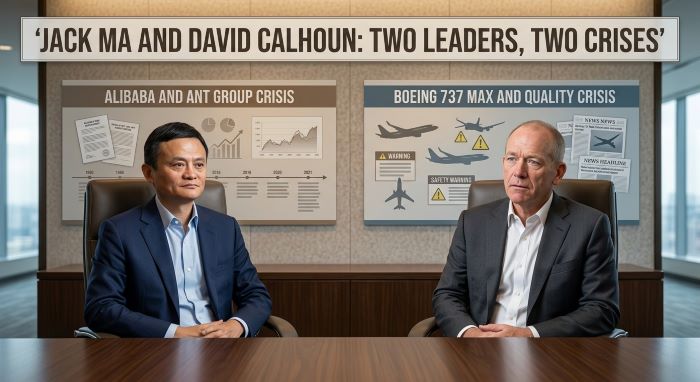
One built a company from a small apartment in Hangzhou and turned it into one of the largest e-commerce empires in the world. The other spent decades climbing the corporate ladder at General Electric before taking over one of America’s most important manufacturers in its darkest hour. Jack Ma and David Calhoun took very different paths, but both ended up as the face of a company under intense public pressure.
There’s no public record of any business deal or partnership between Jack Ma and David Calhoun. People compare them because their stories show two sides of modern leadership: the visionary founder and the professional manager. Both faced moments when governments, regulators, and the public questioned their companies, and both stepped back from the spotlight afterward.
This article compares their backgrounds, education, career timelines, biggest challenges, and the lessons their journeys offer.
Jack Ma and David Calhoun at a Glance
| Jack Ma | David Calhoun | |
|---|---|---|
| Born | September 10, 1964 | April 18, 1957 |
| Age (October 2026) | 62 | 69 |
| Birthplace | Hangzhou, China | Pennsylvania, United States |
| Education | Bachelor’s in English, Hangzhou Normal University (1988) | Bachelor’s in accounting, Virginia Tech (1979) |
| Known for | Co-founding Alibaba | Leading Boeing after the 737 MAX crashes |
| Career path | Teacher turned entrepreneur | Corporate executive |
| Biggest crisis | Ant Group IPO halted (2020) | Alaska Airlines door plug incident (2024) |
| Status in 2026 | Largely out of day to day business, focused on philanthropy | Retired as Boeing CEO in August 2024 |
Early Life and Education
Jack Ma
Jack Ma, born Ma Yun, grew up in Hangzhou in eastern China. His path to success was anything but smooth. He took China’s national college entrance exam, the gaokao, three times before earning a place at university.
He graduated in 1988 with a bachelor’s degree in English from Hangzhou Normal University. As a young man, he practiced English by offering free tours to foreign visitors in Hangzhou, an experience that shaped his worldview.
After graduating, he worked as an English lecturer at Hangzhou Dianzi University.
David Calhoun
David Calhoun was born in Pennsylvania in 1957. He studied accounting at Virginia Tech and graduated in 1979. Decades later, he gave $20 million to Virginia Tech in 2018 to support an honors program, showing his lasting connection to the school.
His education gave him a strong grounding in finance, which became the foundation of his long corporate career.
Career Timeline
Jack Ma’s Career
| Year | Milestone |
|---|---|
| 1988 | Graduates and begins teaching English |
| 1994 | Starts a translation agency |
| 1995 | Launches China Pages, an early online business directory |
| 1999 | Co-founds Alibaba as a business to business marketplace |
| 2013 | Steps down as Alibaba CEO |
| 2014 | Alibaba completes a record IPO of about $25 billion |
| 2019 | Retires as Alibaba executive chairman |
| 2020 | Leaves Alibaba’s board; Ant Group IPO halted in November |
| 2023 | Ant Group restructures, cutting his voting control |
| 2023 to 2024 | Serves as a visiting professor at the University of Tokyo |
| 2025 | Attends a symposium hosted by Chinese President Xi Jinping |
David Calhoun’s Career
| Year | Milestone |
|---|---|
| 1979 | Joins General Electric after college |
| 2005 | Becomes GE vice chairman and board member |
| 2006 | Leaves GE to lead VNU, later renamed Nielsen |
| 2009 | Joins Boeing’s board of directors |
| 2014 | Becomes Nielsen executive chairman and joins Blackstone |
| 2018 | Becomes Boeing’s lead independent director |
| 2019 | Becomes Boeing’s non-executive chairman |
| January 2020 | Becomes Boeing CEO after Dennis Muilenburg’s exit |
| January 2024 | Alaska Airlines door plug incident |
| March 2024 | Boeing announces his planned departure |
| August 2024 | Steps down; Kelly Ortberg becomes CEO |
Two Very Different Paths to the Top
The contrast between Jack Ma and David Calhoun starts with how they rose.
Jack Ma was a founder. He had no technology background and once joked that he knew nothing about technology or marketing. What he had was vision, energy, and the ability to rally people. He built Alibaba from scratch with a small team, betting that the internet could connect Chinese manufacturers with buyers around the world.
David Calhoun was a career executive. He spent 26 years at GE, working in divisions such as transportation, aircraft engines, and lighting. He became known as a skilled operator and turnaround manager, leading Nielsen through its return to the public markets and later overseeing private equity portfolio operations at Blackstone.
One built something new. The other was brought in to steady something enormous.
The Defining Crises
Jack Ma and the Ant Group IPO
In 2020, Ant Group, the financial technology company linked to Alibaba and best known for Alipay, was preparing what was expected to be one of the largest IPOs in history. Shortly before the listing, Jack Ma gave a speech criticizing Chinese financial regulators.
In November 2020, Chinese authorities halted the IPO, citing financial stability concerns. Ma then largely disappeared from public view for months, reappearing in January 2021 at an event for rural teachers.
In the years that followed, Ant Group restructured. In January 2023, Ma’s voting rights in Ant dropped from about 50% to about 6%, ending his control of the company. He spent much of his time abroad, including a period in Japan, where he served as a visiting professor at the University of Tokyo.
David Calhoun and the 737 MAX
Calhoun took over Boeing in January 2020 with a clear mission: rebuild trust after two 737 MAX crashes in 2018 and 2019 that killed 346 people. He also had to steer the company through the COVID-19 pandemic, which devastated air travel.
The biggest blow came in January 2024, when a door plug blew out of an Alaska Airlines 737 MAX 9 shortly after takeoff. No one died, but the incident triggered new investigations and intense criticism of Boeing’s quality control. Calhoun publicly said he was “shaken to the bone.”
In March 2024, Boeing announced he would step down by the end of the year. He left the CEO role in August 2024, and Kelly Ortberg took over.
Comparing Their Leadership Styles
Jack Ma and David Calhoun led in strikingly different ways:
| Trait | Jack Ma | David Calhoun |
|---|---|---|
| Style | Charismatic, visionary, outspoken | Disciplined, operational, measured |
| Strength | Inspiring teams and building from scratch | Running large organizations and managing finances |
| Public image | A celebrity entrepreneur and motivational speaker | A low profile corporate leader |
| Biggest pressure | Government regulators in China | Regulators, airlines, and the flying public |
| Exit | Stepped back gradually from his companies | Departed after a major safety incident |
Wealth and Compensation
Jack Ma became one of the richest people in China through his Alibaba stake. His wealth has fallen from its peak after the regulatory crackdown, but estimates still place his fortune at roughly $27 billion. In early 2024, he reportedly became Alibaba’s largest shareholder after SoftBank reduced its stake.
David Calhoun earned large executive pay packages at Boeing, mostly in stock and options. In 2022, his total compensation was about $22.5 million on a $1.4 million salary. He gave up a $7 million bonus tied to the 777X program in 2023 after delays.
Philanthropy
Jack Ma and David Calhoun have both given back, though in different ways.
- Jack Ma founded the Jack Ma Foundation, which focuses on education, the environment, and public health, with a strong emphasis on supporting rural teachers in China. Time named him to its Time100 Philanthropy list in 2025.
- David Calhoun made a $20 million gift to Virginia Tech in 2018 to support an honors program.
Where Are They Now?
Jack Ma has largely stepped away from running businesses. After years abroad, his appearance at a 2025 symposium with Chinese President Xi Jinping was widely viewed as a sign of improved relations with Beijing. He remains a major Alibaba shareholder and continues his philanthropic work.
David Calhoun has kept a relatively low public profile since leaving Boeing in 2024.
Lessons for Leaders
Comparing Jack Ma and David Calhoun offers several lessons:
- Vision and execution both matter. Ma showed how vision can build an empire. Calhoun’s tenure showed how hard it is to fix deep operational problems.
- Public words carry weight. Ma’s speech criticizing regulators preceded major consequences for his company.
- Culture is hard to change. Calhoun inherited deep safety and quality challenges at Boeing that proved difficult to fix quickly.
- Timing shapes legacies. Ma’s biggest setback came at his company’s peak. Calhoun took over during a crisis and faced a pandemic and a new incident.
- Stepping back can be strategic. Both leaders eventually moved out of the spotlight, letting new leadership move their companies forward.
Why People Compare These Two
There’s no partnership or direct link between Jack Ma and David Calhoun. The comparison draws interest because they represent two leadership archetypes in two of the world’s largest economies, and because both became symbols of how governments and the public hold big companies accountable.
Key Takeaways
- Jack Ma and David Calhoun led Alibaba and Boeing, but there is no known business connection between them.
- Jack Ma, born September 10, 1964, is 62 as of October 2026. He earned an English degree from Hangzhou Normal University and co-founded Alibaba in 1999.
- David Calhoun, born April 18, 1957, is 69 as of October 2026. He studied accounting at Virginia Tech and spent 26 years at General Electric before leading Nielsen and then Boeing.
- Ma’s defining crisis came in November 2020, when Chinese regulators halted Ant Group’s IPO, and his control of Ant ended in a 2023 restructuring.
- Calhoun became Boeing CEO in January 2020 and stepped down in August 2024 after the Alaska Airlines door plug incident.
- Ma’s fortune is estimated at roughly $27 billion, while Calhoun earned about $22.5 million in total pay in 2022.
- Their stories highlight the difference between founder led vision and professional management, and how public scrutiny shapes corporate leadership.