How to Stretch Hip Flexors: Effective Stretches and Technique
Sit for eight hours a day and your hip flexors spend eight hours in a shortened position. Do that for years and they adapt to it, which is why so many people feel a pull across the front of the hip when they stand up straight, and why lower back tightness so often turns out to originate somewhere else entirely. The muscles involved are straightforward to address once you know which stretches actually reach them and how to avoid the technique errors that make them useless. Here is a practical guide.
What the Hip Flexors Are
Understanding the anatomy makes how to stretch hip flexors far more effective. They are a group of muscles at the front of the hip that lift your thigh toward your torso:
- The psoas major, which runs from the lumbar spine down to the femur, crossing the hip joint.
- The iliacus, which originates on the pelvis and joins the psoas, together often called the iliopsoas.
- The rectus femoris, part of the quadriceps, which crosses both the hip and the knee.
- The sartorius and tensor fasciae latae, which assist.
That the psoas attaches to the lumbar spine explains a great deal. Tightness there can contribute to the sensation of lower back tension, which is why people with back complaints are often directed toward hip work.
Why They Get Tight
The dominant reason people search for how to stretch hip flexors is prolonged sitting, which holds the hip in a flexed position for hours at a time. Other contributors include cycling, running without corresponding mobility work, sleeping in a curled position, and general inactivity.
Knowing how to stretch hip flexors matters because tightness there can affect posture, contribute to an anterior pelvic tilt, and influence how the lower back and glutes function.
The Kneeling Hip Flexor Stretch
This is the foundational stretch and the one worth learning properly first:
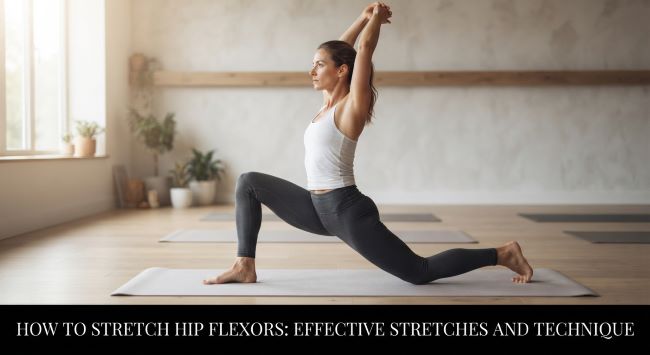
- Kneel on one knee with the other foot flat on the floor in front, forming roughly a right angle at both knees. Use a cushion under the kneeling knee.
- Tuck your pelvis. Squeeze the glute on the kneeling side and tuck your tailbone under. This is the step that makes the stretch work.
- Shift your weight gently forward until you feel a stretch across the front of the kneeling hip.
- Keep your torso upright rather than leaning forward or arching your back.
- Hold for 30 seconds or so, then switch sides.
The pelvic tuck is the difference between a stretch that works and one that does not. Without it, most people simply arch their lower back and feel the movement there instead of in the hip, which is the single most common error in how to stretch hip flexors.
Additional Stretches
Several other options target the same area from different angles:
Couch stretch. Kneeling with the rear foot elevated against a wall, adding knee flexion to target the rectus femoris. It is intense, so approach gradually.
Standing lunge stretch. A standing version, useful when you cannot get on the floor. The same pelvic tuck applies.
Pigeon pose and supine figure four. More glute-focused, but they address the surrounding musculature that contributes to hip mobility.
Bridge. Lying on your back, feet flat, lifting the hips. This engages the glutes, the opposing muscle group, helping the hip flexors release.
Low lunge with reach. Adding an overhead reach and side bend increases the stretch along the front of the body.
Technique Points That Matter
A few principles apply across every approach to how to stretch hip flexors:
| Principle | Why |
|---|---|
| Tuck the pelvis | Directs the stretch to the hip, not the back |
| Keep the torso upright | Prevents compensating with the lower back |
| Breathe steadily | Tension resists lengthening |
| Ease in gradually | Forcing a stretch is counterproductive |
| Hold long enough | Around 30 seconds per side |
| Do both sides | Imbalance causes its own problems |
Stretching should feel like a pull, not a sharp pain. Anything sharp, pinching, or radiating means stop.
A Simple Routine
A short daily routine beats an occasional long session. The kneeling stretch on each side, a bridge to activate the glutes, and a supine figure four takes under ten minutes.
Stretching after activity, when tissues are warm, is more comfortable and effective than stretching cold. Before exercise, dynamic movements like leg swings suit better than long static holds. Consistency over weeks produces results, since tightness built over years of sitting does not resolve in one session.
Beyond Stretching
An honest point about how to stretch hip flexors is that stretching alone often is not the complete answer. If sitting is causing the problem, reducing sitting time addresses the cause rather than treating the symptom repeatedly. Standing periodically and adjusting your workstation both help. Strengthening matters too, since weak glutes and core frequently accompany tight hip flexors, and addressing the whole pattern beats stretching in isolation.
When to See a Professional
While learning how to stretch hip flexors is generally safe, some situations warrant professional input. Consult a doctor or physical therapist for sharp, severe, or persistent hip pain, pain radiating down the leg, pain following an injury, pain that disturbs sleep, or any weakness, numbness, or tingling.
Seek guidance too if you have existing hip conditions, have had hip or back surgery, are pregnant, or if tightness persists despite consistent stretching. A physical therapist can assess whether the issue is genuinely tightness or something else presenting similarly. Persistent pain deserves proper assessment rather than more stretching.
The bottom line on how to stretch hip flexors is that the kneeling hip flexor stretch is the foundation, and the pelvic tuck is what makes it work, since without it you simply arch your lower back and feel nothing in the hip. Add the couch stretch, standing lunge, pigeon pose, and bridges to address the area from different angles, hold each for around 30 seconds, work both sides, and stretch when warm rather than cold. Be consistent over weeks rather than expecting immediate change, address the underlying sitting time and weak glutes rather than only stretching, and see a physical therapist for sharp, persistent, or radiating pain.
Key Takeaways
- The hip flexors include the psoas major, iliacus, rectus femoris, sartorius, and tensor fasciae latae.
- The psoas attaches to the lumbar spine, which is why hip tightness can contribute to lower back tension.
- Prolonged sitting is the dominant cause, holding the hip in a flexed, shortened position for hours.
- The kneeling hip flexor stretch is the foundational exercise and worth learning properly first.
- Tucking the pelvis by squeezing the glute is the key step; without it you arch the back instead.
- Additional options include the couch stretch, standing lunge, pigeon pose, supine figure four, and bridges.
- Hold each stretch around 30 seconds, work both sides, breathe steadily, and ease in gradually.
- Stretching should feel like a pull, never sharp or pinching pain.
- Stretch when warm rather than cold, using dynamic movements before exercise and static holds after.
- Address the cause by reducing sitting and strengthening glutes and core, and see a professional for persistent or radiating pain.