A Designer’s Guide to Necklace Chain Types and Styles
A chain is rarely just a means of suspending a pendant. Look closely and it reveals itself as a study in repetition, proportion, and light. The way a link catches the eye, drapes against the collarbone, or holds a charm without twisting is the product of centuries of quiet engineering. For anyone who appreciates form, understanding the different types of chains is a shortcut to reading how a piece will look and behave long before it is clasped.
Why Chain Structure Matters
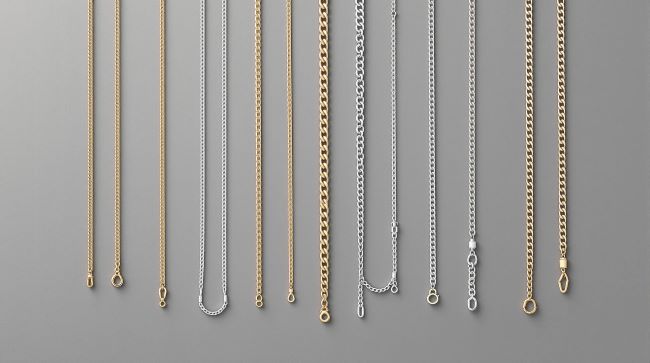
Every chain is defined by the shape of its link and how those links interlock. That single decision governs three things a designer cares about most: how the chain reflects light, how it moves, and how much weight it can carry. A round, open link scatters light softly and drapes with ease; a flat, tightly woven link behaves almost like ribbon, throwing back a continuous sheen. Before choosing between delicate and bold, or between a standalone piece and a pendant carrier, it helps to know the vocabulary.
The Core Chain Types
- Cable chain — the classic: uniform oval links connected in a simple, open pattern. Endlessly versatile, it is the default carrier for pendants and reads as understated and timeless.
- Curb / Cuban — links twisted and flattened so they lie flush against the skin. Curb is the everyday version; Cuban is its heavier, more sculptural cousin, worn confidently on its own as a bold statement.
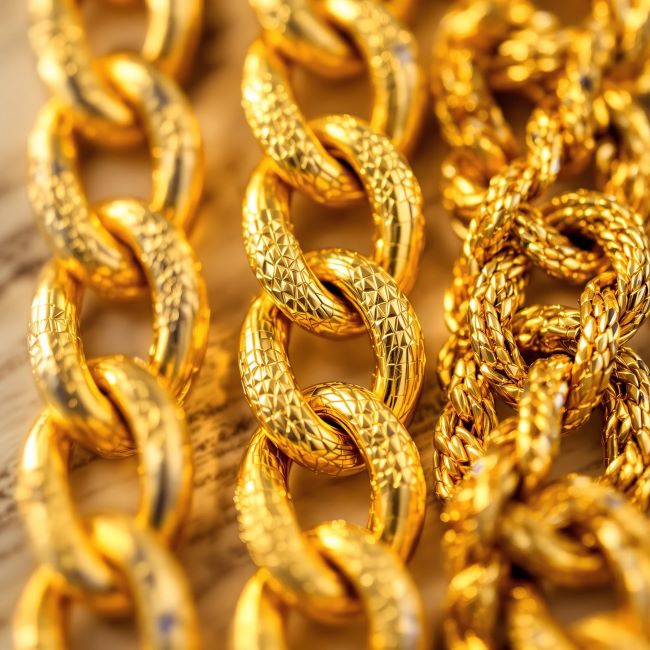
- Rope — several strands twisted together to mimic a length of cordage. It catches light from many angles and carries real presence, working equally well solo or with a substantial pendant.
- Box — square links that form a smooth, angular cube-like line. Sleek and surprisingly sturdy, it suits pendants and holds its shape well.
- Snake — tightly linked plates that create a fluid, near-seamless tube. Smooth and modern, it drapes beautifully but rewards gentle handling.
- Figaro — a rhythmic pattern of alternating long and short links, borrowed from Italian design. Its varied cadence gives it character on its own.
- Paperclip — elongated, rectangular links inspired by the office staple. Contemporary and architectural, it layers well and suits minimalist charms.
- Herringbone — flat, slanted links laid in a continuous ribbon that mirrors like liquid metal. Striking and luxe, but it can kink permanently if bent, so it favors gentle wear.
- Singapore — a twisted chain that lies flat and sparkles as it moves. Delicate and fluid, it resists kinking better than many of its slim peers.
- Bead / Ball — small spheres strung at regular intervals. Casual and tactile, it brings a softer, more playful geometry.
Matching Chain to Purpose
For a pendant, look to cable, box, or rope — their structure supports weight without distorting, and their links sit evenly so a charm hangs true. For a piece meant to stand alone, curb, Cuban, figaro, and herringbone carry enough visual density to be the focal point. Delicate everyday wearers gravitate toward Singapore and fine cable, while box and rope offer a middle ground of quiet durability. Browsing a well-organized range such as ajluxe.com/collections/chain-necklaces is a useful way to see how the same link style shifts in character between polished silver and warm gold plating.
A Note on Durability
Form and resilience are linked. Open designs like cable and rope tolerate everyday knocks and are simple to repair. Herringbone and snake reward the most care: their beauty comes from tight, flat construction that can crimp if caught or folded sharply. Box and curb strike a dependable balance, which is part of why they endure across so many collections. Knowing these tendencies lets a wearer choose not only for looks but for how a piece will age.
Choosing With a Designer’s Eye
The best chain is the one whose structure agrees with its job. Consider how it will catch light in the room it is worn, whether it needs to carry a pendant or speak for itself, and how much handling it will see. Read the link first, then the finish, then the length. Approached this way, a chain stops being an afterthought and becomes what it has always quietly been — a piece of design in its own right.