Mapo Tofu Near Me: How to Find a Great Bowl of Sichuan’s Spiciest Classic
The first time you eat proper mapo tofu, you remember it. Not because it is the prettiest dish on the table, but because your lips went numb and you could not stop eating. That numbing tingle is the signature of Sichuan peppercorn, and combined with chili heat, silky tofu, and savory pork, it creates something no other cuisine replicates. If you are searching for mapo tofu near me, you are chasing a very specific experience, and settling for a watered-down version is worse than not ordering it at all.
What Authentic Mapo Tofu Tastes Like
The dish originates from Chengdu in Sichuan province, and its name translates roughly to “pockmarked grandmother’s tofu,” after the woman credited with inventing it. The classic version hits several flavor notes at once:
- Ma (numbing). Sichuan peppercorn creates a buzzing, tingling sensation on the lips and tongue.
- La (spicy). Dried chili flakes and doubanjiang (fermented chili bean paste) bring the heat.
- Savory depth. Fermented black beans, soy sauce, and pork mince build a meaty, umami-heavy base.
- Silky texture. Soft tofu, usually medium or silken, barely holds its shape in the bubbling sauce.
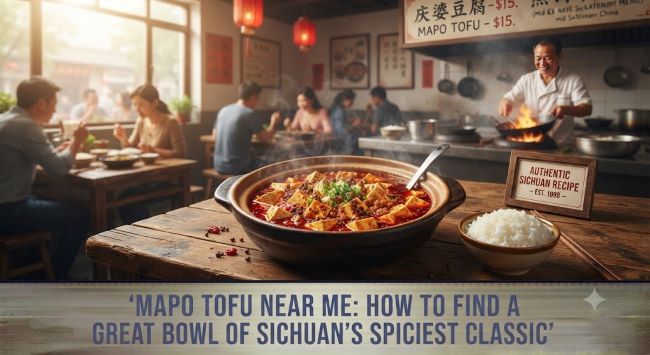
The sauce should be a deep red-brown pool of chili oil with visible flecks of peppercorn. It arrives at the table still bubbling, served over or alongside steamed white rice. Everything about the dish is built around contrast: the soft tofu against the textured pork, the numbing against the burning, the richness against the plain rice.
Where to Find It
When you search for mapo tofu near me, the results split into three tiers of quality:
Sichuan and Szechuan restaurants. This is the target. Restaurants that identify as Sichuan (or the older romanization Szechuan) build their menus around dishes that use chili and peppercorn. Mapo tofu is almost always on the menu, and it is almost always good. These restaurants are common in cities with large Chinese populations: the San Gabriel Valley near Los Angeles, Flushing in Queens, Houston’s Chinatown, the Bay Area, and northern Virginia.
General Chinese restaurants with a Sichuan section. Many Chinese restaurants carry a “Sichuan specialties” or “spicy dishes” sub-menu alongside their Cantonese and American-Chinese items. If mapo tofu appears in that section, it is usually prepared in the Sichuan style. If it appears in the “tofu dishes” section alongside garlic sauce and black bean sauce options, expect a milder, adapted version.
Japanese restaurants. Japan adopted mapo tofu decades ago and developed its own take, called mabo dofu. The Japanese version tends to be milder, less numbing, and slightly sweeter. It is a good dish in its own right but a different experience from the Sichuan original.
Korean and fusion Asian restaurants. The least predictable mapo tofu near me option. Some carry the dish or close variations. Quality varies widely. Check reviews that mention spice level and peppercorn specifically.
How to Judge Quality
Finding mapo tofu near me is step one. Sorting the great from the bland is step two:
| Quality Marker | Good Sign | Bad Sign |
|---|---|---|
| Chili oil | Deep red pool, visibly oily | Pale sauce, no visible oil |
| Sichuan peppercorn | Lips tingle within two bites | No numbness at all |
| Tofu texture | Soft, custardy, barely holding shape | Firm cubes, rubbery |
| Pork | Visible crumbled mince throughout | Missing or sparse |
| Temperature | Arrives bubbling | Arrives lukewarm |
| Garnish | Scallion and ground peppercorn on top | Nothing |
The numbness test is definitive. If you eat three bites and your lips feel normal, the kitchen either skipped the Sichuan peppercorn or used too little. That numbness is not optional. It is the defining element that separates mapo tofu from every other spicy tofu dish.
Ordering Tips
A few small choices improve the experience once you find a solid mapo tofu near me:
- Ask for the Sichuan peppercorn level. Some restaurants adjust for Western palates unless you ask for full strength. Say “authentic spice” or “the way you’d make it for Chinese customers” and the kitchen usually responds.
- Order steamed white rice. Mapo tofu without rice is like soup without a spoon. The rice absorbs the sauce and balances the heat.
- Add a cold appetizer. Smashed cucumber salad or cold sesame noodles cool the mouth between bites.
- Try it with lamb. Some Sichuan restaurants offer a lamb variation that trades pork for ground lamb. The gaminess works surprisingly well with the peppercorn.
Spice Level Reality Check
If you have a low spice tolerance, mapo tofu near me still works for you. Most restaurants offer mild, medium, and hot options. Mild versions reduce the chili but keep the peppercorn, so you get the signature tingle without the burn. Start at medium and adjust next time. Ordering it with no spice at all removes the point of the dish, but mild is a perfectly reasonable starting place.
Making It at Home
If your search for mapo tofu near me turns up empty, the dish requires only about twenty minutes at the stove. The essential ingredients are silken or soft tofu, ground pork, doubanjiang (Pixian brand is the standard), Sichuan peppercorn, garlic, ginger, soy sauce, and a starch slurry to thicken. Everything except the doubanjiang is available at any grocery store, and the paste itself lives at any Asian market or ships cheaply online. One batch feeds two to three people generously and costs a fraction of a restaurant order.
Key Takeaways
- Authentic mapo tofu delivers simultaneous numbing (Sichuan peppercorn) and spicy heat (chili and doubanjiang) with silky tofu and savory ground pork.
- Sichuan-specialty restaurants are the best source; general Chinese restaurants with a Sichuan sub-menu are the second-best option.
- The numbness test is definitive: if your lips are not tingling by the third bite, the kitchen went too light on peppercorn.
- Japanese mabo dofu is a milder, sweeter adaptation worth trying but different from the Sichuan original.
- Always order steamed white rice alongside it, and ask for authentic spice levels if you want the full experience.
- Whatever mapo tofu near me option you choose, start at medium spice if you are heat-sensitive; mild still preserves the peppercorn tingle without overwhelming burn.
- If no Sichuan restaurant exists nearby, the dish takes about twenty minutes to cook at home with doubanjiang, peppercorn, tofu, and ground pork.
- Cities with the strongest Sichuan restaurant scenes include the San Gabriel Valley, Flushing, Houston, the Bay Area, and Northern Virginia.