Medical Billing and Coding Jobs: A Complete Career Guide
Medical billing and coding has become one of the more accessible entry points into the healthcare administrative field, offering the appeal of stable, in-demand work that doesn’t require the years of clinical training that direct patient care roles do, while still operating within the broader healthcare system. Understanding what these roles actually involve day to day, what certifications genuinely matter, what realistic pay expectations look like, and how to break into the field helps you evaluate whether this career path is a good fit for your specific situation and goals.
What Medical Billers and Coders Actually Do
While often discussed together, medical billing and medical coding are technically distinct functions, sometimes performed by the same person (particularly in smaller practices) and sometimes split into separate specialized roles (more common in larger healthcare organizations).
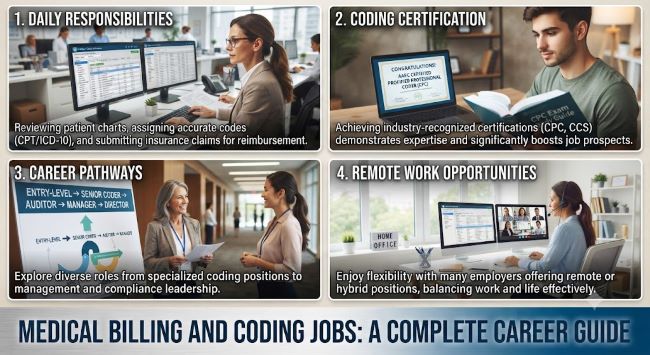
Medical coders translate healthcare services, diagnoses, and procedures documented in patient records into standardized alphanumeric codes (using systems including ICD-10 for diagnoses, CPT for procedures, and HCPCS for additional supplies and services), a process requiring genuine attention to detail and accuracy, since these codes directly determine how healthcare providers are reimbursed by insurance companies and government payers.
Medical billers use the codes generated by coders (or generate their own codes in combined billing-and-coding roles) to create and submit claims to insurance companies, follow up on claim denials or underpayments, communicate with patients regarding billing questions and payment plans, and generally manage the financial transaction side of healthcare service delivery.
Combined billing and coding roles, common particularly in smaller medical practices and clinics, handle both functions, requiring a broader skill set but offering correspondingly more job opportunities at smaller healthcare organizations that don’t have the staffing volume to justify fully separate specialized positions for each function.
Where Medical Billing and Coding Professionals Work
Hospitals, generally offering the largest, most specialized coding and billing departments given the volume and complexity of services hospitals provide, often with specialized coders focusing on specific medical specialties or service lines.
Physician practices and clinics, ranging from small independent practices needing combined billing-and-coding generalists to larger multi-specialty practices with more departmental specialization similar to hospital settings.
Insurance companies, employing coders and billing specialists to review and process claims from the payer side of the healthcare transaction, a meaningfully different perspective and skill application compared to provider-side billing and coding roles.
Medical billing companies, third-party organizations that handle billing and coding services on behalf of multiple healthcare provider clients, a growing segment of the industry as more practices outsource this function rather than maintaining it entirely in-house.
Remote and work-from-home positions, which have become increasingly common in this field specifically, since the core work (reviewing documentation, applying codes, submitting claims, and communicating with insurance companies) can generally be performed effectively from a home office setup with appropriate computer access and secure connection to the relevant healthcare systems and software, making this one of the more remote-work-friendly entry points into the broader healthcare field.
Certifications and Qualifications
Certified Professional Coder (CPC), offered by the American Academy of Professional Coders (AAPC), is one of the most widely recognized and requested coding certifications by employers, generally requiring passing a comprehensive exam covering coding systems, anatomy, and medical terminology.
Certified Coding Specialist (CCS), offered by the American Health Information Management Association (AHIMA), is another widely recognized certification, often associated specifically with hospital-based coding roles given its particular emphasis on inpatient coding complexity.
Certified Billing and Coding Specialist (CBCS) and similar combined certifications address the dual billing-and-coding skill set specifically, relevant for the combined roles common at smaller practices discussed above.
Formal education programs, ranging from certificate programs (often completable in under a year) at community colleges and vocational schools, to associate degree programs in health information technology or medical billing and coding specifically, generally provide both the foundational knowledge needed to pass certification exams and, in many cases, are specifically structured around preparing students for these exact certification exams.
Most employers in this field genuinely prioritize relevant certification over a specific degree level, making the certification itself, rather than a four-year degree, the more critical credential for most entry-level and many mid-level positions in this specific field.
What Medical Billing and Coding Jobs Pay
Compensation varies by certification level, specialization, geographic location, and whether the role is billing-focused, coding-focused, or combined:
Entry-level (newly certified): $40,000-$50,000 annually in most markets, with significant variation by region and cost of living.
Experienced coders (3+ years, specialized certification): $50,000-$65,000 annually, with specialized inpatient or outpatient hospital coders, particularly those with additional specialty certifications, often commanding higher rates within this range.
Senior coding specialists and coding auditors: $65,000-$85,000+, particularly for roles requiring deep expertise in complex specialty coding or compliance auditing functions.
Remote positions can offer competitive pay comparable to in-office roles in many cases, though geographic pay variation sometimes still applies depending on the specific employer’s compensation structure for remote staff.
How to Find Medical Billing and Coding Job Openings
Indeed, LinkedIn, and ZipRecruiter, searching specifically for “medical coder,” “medical biller,” or “medical billing and coding specialist” combined with your location or “remote” if you’re specifically seeking work-from-home opportunities.
AAPC and AHIMA career resources, both major certifying organizations maintain job boards and career resources specifically connecting certified professionals with relevant openings.
Hospital and healthcare system career pages directly, since larger healthcare employers often post openings on their own career sites before or alongside general job boards.
Medical billing company websites, particularly relevant for remote-focused job seekers, since third-party billing companies often have a higher proportion of remote positions compared to in-house hospital or clinic roles.
Getting Started in the Field
For those new to healthcare administration entirely, starting with a certificate program specifically focused on medical billing and coding, then pursuing the relevant certification exam (CPC or CCS depending on your specific career interest), provides the most direct path into the field. Many community colleges offer these programs at a meaningfully lower cost than a full degree program while still providing the specific preparation needed to pass certification exams and qualify for entry-level positions.
For those exploring adjacent healthcare career paths to compare against medical billing and coding specifically, nurse practitioner jobs near me and registered nurse jobs near me cover clinical healthcare career paths requiring more extensive education and licensure but offering direct patient care roles, useful comparison points if you’re weighing administrative versus clinical healthcare career directions. For other accessible entry-level career paths with similarly remote-work-friendly potential outside healthcare specifically, data entry jobs offers a different career direction worth considering if you’re comparing accessible entry points across various fields more broadly.
Key Takeaways
- Medical coders translate healthcare services and diagnoses into standardized codes (ICD-10, CPT, HCPCS), while medical billers use those codes to submit insurance claims and manage the financial side of healthcare transactions, with smaller practices often combining both functions into a single role
- The field offers genuinely strong remote work potential, since the core work of reviewing documentation and processing claims can typically be performed effectively from a home office with appropriate system access
- Certification (CPC from AAPC or CCS from AHIMA) generally matters more to employers than a specific degree level, making certificate programs a more direct and affordable entry path than a full degree for most positions
- Entry-level pay typically ranges $40,000-$50,000 annually, with experienced specialized coders earning $50,000-$65,000, and senior coding auditors or specialists reaching $65,000-$85,000+
- Find openings through Indeed and LinkedIn, AAPC and AHIMA career resources, hospital system career pages directly, and medical billing company websites specifically for remote-focused opportunities
- The field works across hospitals, physician practices, insurance companies, and third-party medical billing companies, each offering somewhat different work environments and specialization opportunities
- Starting with a focused certificate program followed by the relevant certification exam provides the most direct, cost-effective path into entry-level positions in this field