Fun Things to Do Near Me: A Complete Guide to Finding Local Activities
The search for “fun things to do near me” usually comes from one of two genuinely different places: either you’re filling open time and want fresh ideas, or you’re specifically trying to plan something for a particular occasion, visitor, or date. Both situations benefit from knowing where to actually look beyond just a generic search, since the right tool or approach depends heavily on what kind of activity you’re actually hoping to find.
Apps and Websites Built Specifically for Local Activity Discovery
Eventbrite. One of the most comprehensive sources for scheduled local events specifically, covering everything from concerts and workshops to food festivals and community gatherings, filterable by date range, category, and price (including a genuinely useful filter for free events specifically).
Meetup. Particularly strong for finding recurring activity-based groups built around shared interests — hiking groups, board game nights, professional networking, language exchange, and countless other specific interest categories — making it a particularly good resource if you’re looking for an ongoing activity to join repeatedly rather than just a single one-off event.
Google Maps “Things to do” feature. Searching your city or neighborhood name plus “things to do” in Google Maps surfaces a curated list of popular local attractions, activities, and points of interest, often including user ratings and photos that help you quickly evaluate options before committing time to research any single one in depth.
Local city or tourism board websites. Most cities maintain an official tourism or visitor’s bureau website with curated event calendars and activity recommendations, often including genuinely useful seasonal or time-limited event information (holiday markets, seasonal festivals) that might not surface as prominently through general app-based searches.
Local news outlet event calendars. Many local newspapers and news websites maintain a “things to do this weekend” style regularly updated feature, often compiling a genuinely useful curated list specifically tailored to current local happenings rather than a generic year-round activity database.
Categories of Activities Worth Considering
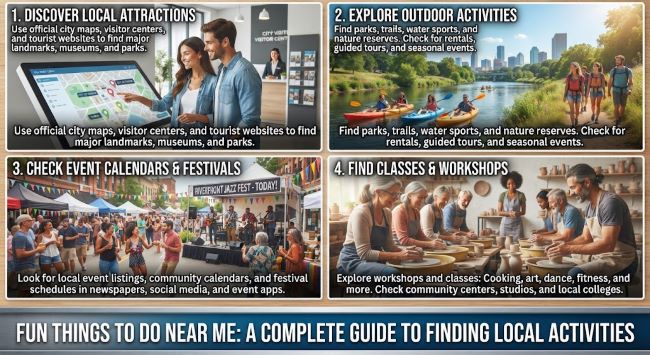
Outdoor and nature-based activities. Local parks, hiking trails, botanical gardens, and nature centers often offer genuinely engaging activities at low or no cost, and searching specifically for “[your city] parks and recreation department” frequently surfaces a more complete list of public outdoor spaces and programming than a generic search alone might reveal.
Museums and cultural institutions. Beyond the most obviously prominent museums in any given city, many areas have smaller, more specialized museums (historical societies, niche interest museums, university-affiliated galleries) that receive considerably less search visibility despite often offering a genuinely interesting and less crowded experience compared to a city’s most famous, heavily trafficked attractions.
Food and drink experiences. Beyond simply dining out, consider food tours, brewery or winery tastings, cooking classes, and food festivals as activity categories in their own right rather than purely as a meal, since many cities have a genuinely robust calendar of food-and-drink-centered events worth specifically searching for.
Live entertainment. Local theater (including smaller community theater groups, not just major touring productions), live music venues, comedy clubs, and trivia nights at local bars all represent accessible entertainment options that don’t always rank prominently in generic “things to do” searches compared to more heavily marketed major attractions.
Classes and workshops. Pottery studios, art classes, cooking schools, and similar hands-on workshop offerings provide a genuinely different kind of activity experience compared to passive entertainment options, often bookable through platforms like ClassPass or directly through the specific studio or instructor’s own booking system.
Seasonal and time-limited events. Farmers markets, holiday festivals, seasonal fairs, and similar time-limited events are easy to miss if you’re not specifically checking for them, since they don’t appear in general “permanent attraction” style search results the way a museum or park would.
Tips for Finding Genuinely Good Options, Not Just Popular Ones
Cross-reference multiple sources rather than relying on a single app or search. Different platforms surface different types of activities based on how they’re structured and who tends to use them, meaning checking Eventbrite, Google Maps, and a local community Facebook group for the same general search will often produce a meaningfully different and more complete combined picture than relying on any single source alone.
Read recent reviews with attention to specifics, since a venue or activity’s overall popularity ranking doesn’t always reflect whether it’s currently operating at its best, with recent reviews mentioning specific details (current condition, current staff quality, any recent changes) generally more useful than relying purely on an aggregate historical rating.
Ask locally, not just digitally. Local Facebook groups, Nextdoor, and even simply asking a barista, hotel front desk, or rideshare driver “what do locals actually do for fun around here” often surfaces genuinely well-regarded local options that don’t have the marketing budget or search optimization of more heavily promoted major attractions.
Consider the day and time you’re actually planning to go. Some activities are significantly better experienced at specific times (a farmers market at opening versus closing, a popular hiking trail at sunrise versus midday crowds), and factoring this into your planning, rather than just identifying an activity in the abstract, improves your actual experience considerably.
Don’t overlook free or very low-cost options. Public libraries increasingly host genuinely interesting community events and programming, many museums have free admission days or hours, and numerous outdoor and public spaces offer engaging activities without requiring significant spending, an important category to specifically search for if budget is a meaningful consideration in your planning.
Matching Activities to Your Specific Situation
Solo time to fill: consider a class or workshop, a museum visit, or simply exploring a new neighborhood on foot, all activities that work well independently without requiring coordination with others.
Planning for visiting friends or family: lean toward activities that showcase what’s genuinely distinctive about your specific area rather than generic options available anywhere, since visitors typically value local character and specificity over conventional entertainment they could find in their own city.
A date or romantic outing: activities involving some shared, interactive element (a cooking class, a trivia night, an interesting walking tour) often facilitate better conversation and connection than purely passive entertainment options where you’re simply sitting side by side without much natural interaction.
A group outing with mixed interests: look for venues or events offering multiple simultaneous activity options (a larger festival, a venue with both food and entertainment components) so different members of your group can find something genuinely appealing within the same general outing.
Key Takeaways
- Finding genuinely good local activities benefits from cross-referencing multiple sources rather than relying on a single generic search: Eventbrite, Meetup, Google Maps, local tourism boards, and local news event calendars each surface different types of options
- Activity categories worth specifically considering include outdoor and nature-based options, smaller specialized museums often overlooked compared to major attractions, food and drink experiences beyond simple dining, live entertainment at smaller venues, hands-on classes and workshops, and seasonal time-limited events
- Reading recent reviews with attention to specific details, rather than relying purely on aggregate historical ratings, helps identify whether a venue or activity is currently operating at its best
- Asking locally through community groups or simply asking residents directly often surfaces well-regarded options that lack the marketing reach of more heavily promoted major attractions
- Consider the specific day and time you’re planning to visit, since many activities are meaningfully better experienced at certain times compared to others
- Match your activity choice to your specific situation: solo time, visiting friends, a date, or a mixed-interest group outing each benefit from different types of activities and venues
- Don’t overlook free or low-cost options like public library programming, museum free-admission days, and public outdoor spaces, which offer genuinely engaging activities without significant spending