Aluminum Free Deodorant: What It Is, Why People Choose It, and the Best Options
Aluminum free deodorant has moved from a niche natural-products category into a mainstream personal care choice, with most major drugstores and beauty retailers now stocking multiple brands alongside conventional antiperspirants. Understanding the actual difference between deodorant and antiperspirant, why people choose to go aluminum-free, and which products genuinely work helps you make an informed switch rather than guessing your way through trial and error.
Deodorant vs. Antiperspirant: The Core Difference
This distinction is the foundation of understanding aluminum free deodorant.
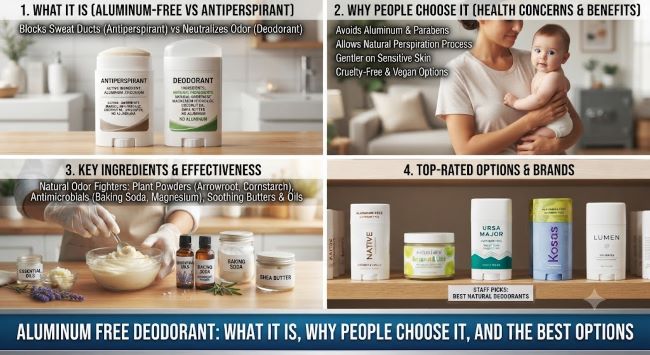
Antiperspirants contain aluminum-based compounds (aluminum chloride, aluminum zirconium, aluminum chlorohydrate) that work by temporarily plugging sweat ducts, physically reducing the amount of sweat that reaches the skin’s surface. This is why antiperspirants are effective at reducing visible sweat and wetness, not just odor.
Deodorants work differently: they don’t stop sweat production at all. Instead, they target the bacteria on skin that breaks down sweat into odor-causing compounds (sweat itself is largely odorless; the smell comes from bacterial activity on skin). Deodorants use antibacterial ingredients, fragrance, and odor-absorbing ingredients to manage smell without affecting sweat volume.
This means aluminum free deodorant will not reduce how much you sweat — only conventional antiperspirants do that. If reducing visible sweat and wetness is your primary concern, an aluminum-free product won’t address that specific issue, regardless of brand or formulation quality. If your primary concern is odor rather than wetness, aluminum-free deodorant can be just as effective as antiperspirant for many people.
Why People Choose Aluminum Free Deodorant
Health concerns about aluminum absorption. Some research has explored potential links between aluminum-based antiperspirants and breast cancer or Alzheimer’s disease. Major health organizations, including the American Cancer Society and Alzheimer’s Association, state that current scientific evidence does not support a definitive causal link, but ongoing research and personal risk tolerance lead many people to choose aluminum-free options as a precaution.
Skin sensitivity. Some people experience irritation, rash, or contact dermatitis specifically from aluminum compounds, and switching to aluminum-free formulas resolves the irritation.
Avoiding pore blockage. Some people prefer not to block sweat ducts at all, viewing natural perspiration as a normal bodily function they don’t want to interfere with, separate from any specific health concern.
Preference for “clean” or natural ingredient lists. Many aluminum-free deodorants are formulated as part of a broader “clean beauty” or natural personal care approach, often pairing the aluminum-free claim with other ingredient exclusions (parabens, synthetic fragrance, phthalates).
What Actually Controls Odor in Aluminum Free Formulas
Baking soda (sodium bicarbonate). A common and effective odor-neutralizing ingredient in natural deodorants. Effective for many people, but a notable percentage of users report skin irritation or rash from baking soda, particularly with daily use over time. If you try a baking-soda formula and develop irritation, this ingredient is the most likely cause and baking-soda-free formulas are worth trying instead.
Magnesium hydroxide. An alternative odor-control ingredient that’s gentler on skin than baking soda for many users while still providing effective bacterial odor control, commonly found in formulas marketed toward sensitive skin.
Probiotic and prebiotic ingredients. Some newer formulations use ingredients designed to support a healthier skin microbiome balance, theoretically reducing the bacterial activity responsible for odor at the source.
Essential oils and natural antibacterials. Tea tree oil, coconut oil (which has natural antimicrobial properties), and various essential oils contribute both fragrance and mild antibacterial action in many natural formulations.
Charcoal and clay. Activated charcoal and various clays are included in some formulas for their odor-absorbing properties.
Zinc-based ingredients. Zinc ricinoleate and similar compounds work by binding to odor molecules rather than masking them, used in many premium aluminum-free formulations.
Top Aluminum Free Deodorant Options
Native Deodorant. Widely available and one of the more mainstream aluminum-free brands, using a coconut oil and shea butter base with baking soda in most formulas (also offers a baking-soda-free “Sensitive” line for those who react to baking soda).
Schmidt’s Naturals. Offers both baking-soda and baking-soda-free (magnesium-based “Sensitive Skin” line) options, widely available at major retailers, with a strong range of natural scent options.
Each & Every. Formulated specifically for sensitive skin, using a minimal ingredient list with arrowroot powder and essential oils rather than baking soda, frequently recommended for people who’ve had irritation issues with other natural deodorants.
Kopari Coconut Deodorant. Coconut oil-based formula without baking soda, popular for a gentler scent profile and skin feel.
Necessaire The Deodorant. A premium option with a clinical, dermatologist-developed formula using AHA and other skin-conditioning ingredients alongside odor control, positioned for people wanting an elevated, fragrance-forward natural option.
Lume. Markets itself specifically around whole-body odor control (not just underarms) using a patented odor-control technology different from baking soda or traditional natural ingredient approaches.
Managing the Adjustment Period
Many people switching from antiperspirant to aluminum free deodorant experience an “armpit detox” period of one to four weeks where odor and sweat may seem worse than usual before stabilizing. This is commonly attributed to the body’s sweat glands and skin microbiome adjusting after the pore-blocking effect of antiperspirant is removed, though the mechanism isn’t fully scientifically established and not everyone experiences a noticeable adjustment period.
To manage this transition: be patient through the first few weeks, consider showering and reapplying midday if needed during the adjustment period, and don’t conclude a product “doesn’t work” based on the first week alone — give any new formula at least two to three weeks before judging its effectiveness for your body chemistry.
Finding the Right Formula for Your Body
Individual skin chemistry and bacterial flora vary significantly, which is why a deodorant that works perfectly for one person may be ineffective for another. If your first aluminum-free deodorant doesn’t control odor adequately after a fair adjustment trial, don’t assume aluminum-free options as a category don’t work for you — try a different active ingredient base (switching from baking soda to magnesium hydroxide, for example) before concluding the category isn’t viable for your body.
For where to find these products locally and explore the broader category in person, beauty supply near me covers how to locate stores carrying a wide range of personal care brands where you can compare aluminum-free options directly.
Key Takeaways
- Aluminum free deodorant addresses odor by targeting bacteria, while conventional antiperspirant additionally blocks sweat ducts to reduce wetness: choose based on whether wetness or just odor is your primary concern
- Common active odor-control ingredients include baking soda (effective but can irritate skin), magnesium hydroxide (gentler alternative), zinc compounds, and various essential oils and natural antibacterials
- Top brands include Native, Schmidt’s, Each & Every (specifically for sensitive skin), Kopari, Necessaire, and Lume, each with different ingredient approaches worth trying if one formula doesn’t work for you
- Health concerns about aluminum (potential links to cancer or Alzheimer’s) remain scientifically inconclusive according to major health organizations, but skin sensitivity and ingredient preference are equally common reasons for switching
- Many people experience a 1-4 week adjustment period when switching from antiperspirant: give a new formula adequate trial time before judging its effectiveness
- If baking-soda formulas cause irritation, switch to a magnesium hydroxide or baking-soda-free formula rather than concluding aluminum-free deodorant doesn’t work for your skin
- Individual body chemistry varies significantly: trying a few different formulas is often necessary to find the one that works best for your specific skin and bacterial profile