How to Get Nail Glue Off Skin: Safe Methods That Actually Work
Nail glue on skin is one of those small disasters that happens fast and then refuses to go anywhere. One moment you’re pressing a nail into place, and the next your fingers are bonded together or stuck to the surface you were working on. The good news is that nail glue, which is essentially cyanoacrylate (the same compound in super glue), responds to a handful of reliable removal methods that won’t damage your skin if done correctly. This guide covers how to get nail glue off skin using what you already have at home, what to avoid, and what to do in the few situations where more care is needed.
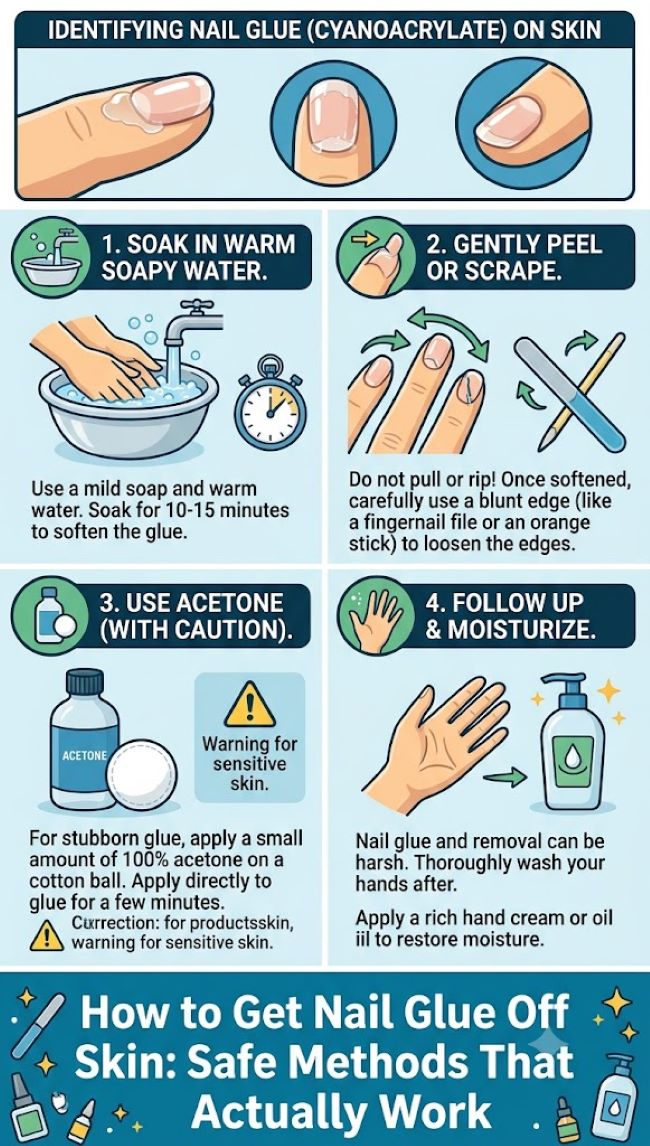
Why Nail Glue Bonds So Stubbornly to Skin
Cyanoacrylate adhesives cure through a reaction with moisture. Skin has plenty of it, which is why nail glue bonds so quickly and firmly when it makes contact. The bond is genuine: cyanoacrylate forms strong polymer chains on contact with moisture, which is the same mechanism that makes it effective for attaching nails in the first place.
The upside is that cyanoacrylate, while strong, is not chemically aggressive on skin the way some industrial adhesives are. The bond can be broken safely using the right solvents and patience. Trying to peel or pull bonded skin apart by force is the one approach that causes actual injury, and it’s worth resisting that impulse entirely.
Method 1: Acetone (Nail Polish Remover)
Acetone is the most effective solvent for how to get nail glue off skin, and it’s present in most standard nail polish removers. Pure acetone (available at hardware stores and beauty supply shops) works faster than acetone-based nail polish remover, which contains additives that dilute it slightly.
What you need: acetone or acetone-based nail polish remover, cotton balls or pads, warm water, soap, and a moisturizer for after.
Steps:
Soak a cotton ball in acetone and hold it against the glued area for thirty to sixty seconds. Don’t rub aggressively: let the solvent do the work by softening the adhesive bond rather than abrading it off. The glue will begin to soften and lose its grip.
Once you feel the bond softening, gently roll or peel the skin apart rather than pulling. If it doesn’t come apart easily, soak again for another thirty seconds and try again. Multiple short soaks are safer than one extended soak.
After the glue is removed, wash the area thoroughly with soap and warm water to remove all acetone residue, then apply a moisturizer. Acetone strips the skin of its natural oils and can leave it dry if not addressed.
Important note: Acetone is safe for most skin but should not be used on broken skin, open cuts, or areas of irritation. Avoid getting it in your eyes. If glue has bonded your eyelid or the area directly around your eyes, skip acetone entirely and use the warm water soak method described below.
Method 2: Warm Soapy Water Soak
If acetone isn’t available, or if the glued area is sensitive, warm soapy water is the gentlest method for how to get nail glue off skin. It’s slower than acetone but effective with patience.
Fill a bowl with warm (not hot) water and add a generous squirt of dish soap or hand soap. Submerge the affected area and let it soak for ten to fifteen minutes. The warmth softens the adhesive and the soap reduces the surface tension that helps the bond hold.
After soaking, try to gently peel or roll the glued skin apart. If it doesn’t release, soak for another five to ten minutes. This method is particularly useful for fingertips bonded together because extended soaking is comfortable and the soap is not irritating.
This is the right approach for glue near the eye area: soak a clean cloth in warm soapy water and hold it gently against the closed eye or surrounding skin. Never apply acetone near the eyes.
Method 3: Oils and Petroleum Jelly
Oils work by penetrating along the edges of the adhesive bond and breaking down its grip from the sides inward. This method is slower than acetone but is the most skin-friendly option and causes no dryness or irritation.
Any of the following work: coconut oil, olive oil, baby oil, petroleum jelly (Vaseline), or cuticle oil. Apply a generous amount directly to the glued area and work it in around the edges. Leave it for several minutes, then gently try to peel or roll the skin apart. Reapply and wait again if needed.
This method is particularly good for cuticle areas and the skin around the nail where acetone can be irritating, and for anyone with sensitive skin who finds acetone uncomfortable. It’s also the safest approach for anyone whose skin is dry or prone to cracking.
Method 4: Salt and Water Scrub
A gentle salt and water paste works as a mild exfoliant that can loosen nail glue on skin when combined with rubbing. Mix table salt with just enough warm water to form a paste, apply it to the glued area, and gently scrub in circular motions. This won’t dissolve the glue chemically but can physically wear down thinner glue deposits on the surface of the skin.
This method works best for small amounts of glue that didn’t bond deeply: the kind that got on your fingertip in a thin layer rather than a pooled deposit. For thick or well-bonded glue, use acetone or an extended soak instead.
What Not to Do
Don’t force-peel bonded skin apart. This is the most important point in how to get nail glue off skin safely. Cyanoacrylate bonds skin strongly enough that forcing it apart can tear the skin itself, causing a wound that is more painful and takes longer to heal than the time it would have taken to dissolve the glue properly.
Don’t use sharp tools to scrape the glue off. Knives, scissors, or fingernails used as scrapers on bonded skin risk cutting yourself. Scraping works for glue on hard surfaces, not on skin.
Don’t use non-acetone nail polish remover as an equivalent. Non-acetone removers use ethyl acetate rather than acetone and are significantly less effective at dissolving cyanoacrylate. If you need a solvent, acetone is what works.
If Glue Gets in or Near Your Eyes
Nail glue bonding the eyelids shut is genuinely alarming but is not a medical emergency in most cases. Cyanoacrylate does not bond well to the moist mucous membranes of the eye itself. Keep the eye closed, apply a warm wet cloth to the area, and the bond will typically loosen within one to four hours. Do not try to force the eye open and do not use acetone near the eye. If the eye remains bonded after several hours or there is any pain inside the eye itself, contact a medical professional.
For other beauty and personal care tips around nail and skin care, low maintenance short natural haircuts for black females covers a different aspect of personal care, but the principle of knowing your tools and materials before using them applies just as well to nail glue as to hair products.
Key Takeaways
- Nail glue is cyanoacrylate: it bonds through moisture contact and is dissolved most effectively by acetone, warm soapy water soaks, or oils
- Acetone (pure or in nail polish remover) is the fastest method: soak for thirty to sixty seconds, gently peel apart, repeat as needed, then moisturize
- Warm soapy water is the gentlest method and the correct choice for sensitive skin, cuticle areas, and anything near the eyes
- Oils (coconut, olive, baby oil, petroleum jelly) penetrate the bond from the edges and are the most skin-friendly option with no irritation risk
- Never force bonded skin apart: cyanoacrylate bonds strongly enough to tear skin if pulled without prior softening
- For glue near or on the eyelid: warm wet cloth only, no acetone, and patience: the bond typically releases within one to four hours
- After using acetone, always wash the area and apply moisturizer to replace stripped natural oils