How to Draft a Better Lease Agreement for a Commercial Rental Property
A commercial lease agreement is one of the most important documents in any commercial real estate transaction. Whether the property is an office building, retail space, warehouse, restaurant, industrial facility, or mixed-use development, the lease serves as the foundation of the landlord-tenant relationship. It establishes expectations, allocates responsibilities, and provides a framework for addressing issues that may arise during the tenancy.
Yet many commercial lease disputes can be traced back to one common problem: unclear lease language. When important terms are vague, incomplete, or poorly drafted, misunderstandings become more likely. What
A well-drafted commercial lease does more than simply state the rent amount and lease term. It anticipates potential issues, clearly defines each party’s responsibilities, and reduces uncertainty wherever possible. Although every property and tenancy is unique, there are several principles that can help landlords create stronger commercial lease agreements.
Start With Clear and Precise Language
One of the most effective ways to improve a commercial lease agreement is surprisingly simple: eliminate ambiguity. Commercial leases are often lengthy documents filled with legal terminology and industry-specific concepts. While certain legal language may be necessary, clarity should always remain a priority. For example, terms such as “common area maintenance,” “operating expenses,” “permitted use,” and “material default” should be carefully defined. Leaving key provisions open to interpretation can create confusion and increase the likelihood of future disputes.
The goal is not necessarily to make the lease shorter. Instead, it is to ensure that both parties can understand their rights and obligations without guessing what specific provisions were intended to mean.
Clearly Define the Permitted Use
One of the most important sections of any commercial lease involves the tenant’s permitted use of the property. A landlord may assume the tenant intends to operate a certain type of business, but assumptions are rarely a substitute for precise lease language.
The lease should clearly identify what activities are permitted on the premises and whether any restrictions apply. This helps ensure that the property is used consistently with the landlord’s expectations and can also help prevent conflicts between tenants in multi-tenant developments. A carefully drafted use clause can protect both parties by establishing clear boundaries from the outset.
Address Maintenance and Repair Responsibilities Thoroughly
Commercial lease disputes frequently arise over maintenance and repair obligations. Tenants may assume certain repairs are the landlord’s responsibility. Landlords may believe the tenant is responsible. Without clear language, disagreements become inevitable.
A strong lease should specify which party is responsible for maintaining and repairing various components of the property. This may include roofing systems, HVAC equipment, plumbing, electrical systems, parking areas, structural components, landscaping, and interior improvements. The more detailed these provisions are, the less room there is for misunderstanding later.
Specify Rent and Additional Charges Carefully
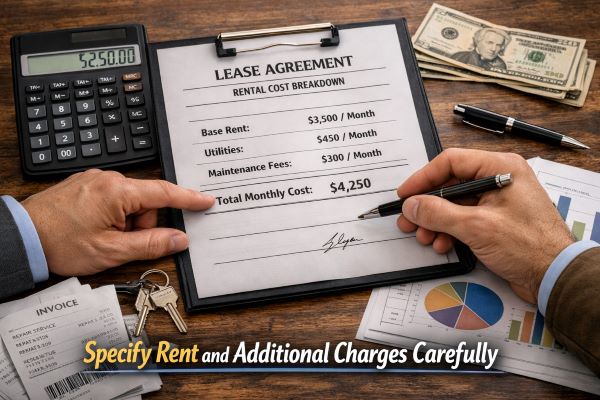
Rent is obviously one of the most important provisions in any lease agreement, but commercial leases often involve more than base rent alone. Additional expenses such as property taxes, insurance costs, common area maintenance charges, utilities, and operating expenses may also be allocated between the parties. The lease should clearly explain how these expenses are calculated, billed, and paid. Tenants should understand exactly what financial obligations they are assuming, and landlords should avoid relying on vague descriptions that could create confusion later. When it comes to rent and expenses, specificity is almost always beneficial.
Plan for Growth and Change
Businesses rarely remain exactly the same throughout the life of a commercial lease. A tenant may expand operations, modify services, change ownership structures, or pursue new business opportunities. Similarly, landlords may make improvements to the property, add tenants, or alter building operations.
A strong lease anticipates change rather than assuming conditions will remain static. Assignment and subleasing provisions, expansion options, renewal rights, signage rules, and alteration procedures all help address circumstances that may evolve over time. Including well-considered provisions for future changes can make the lease more adaptable and reduce the need for later disputes or renegotiations.
Do Not Overlook Dispute Resolution Procedures
No landlord enters a lease expecting conflict, but disagreements sometimes happen despite everyone’s best intentions. Including dispute resolution provisions can help establish a roadmap for addressing those situations. Depending on the goals of the parties, the lease may address mediation, arbitration, venue selection, attorney fee provisions, notice procedures, or other mechanisms designed to manage disputes efficiently. The specific approach will vary depending on the property and circumstances, but addressing these issues in advance can reduce uncertainty if disagreements eventually arise.
A Better Lease Creates a Better Landlord-Tenant Relationship
Commercial lease agreements are about much more than collecting rent. They establish expectations, allocate responsibilities, manage risks, and provide a framework for a successful tenancy. When drafted thoughtfully, they help prevent misunderstandings and create greater certainty for both parties.
By emphasizing clarity, carefully defining responsibilities, addressing financial obligations thoroughly, planning for future changes, and allocating risks appropriately, landlords can create lease agreements that are more effective and easier to administer. While no document can eliminate every possible dispute, a well-drafted commercial lease can significantly reduce the likelihood of conflict and contribute to a stronger, more productive landlord-tenant relationship.