Best Arroz Chaufa Near Me: Peru’s Chinese-Peruvian Fried Rice Explained
Most people are familiar with Chinese fried rice. Fewer know that Peru has its own deeply ingrained version, developed over more than a century of Chinese immigration, that has become one of the most popular everyday dishes in the country. Arroz chaufa is not a gimmick or a fusion experiment. It’s the result of Chinese cooking techniques applied to Peruvian ingredients, cooked by people who grew up with both traditions, and it produces something distinct from either parent cuisine. If you’ve been looking for the best arroz chaufa near me, here’s what it is and how to find it done right.
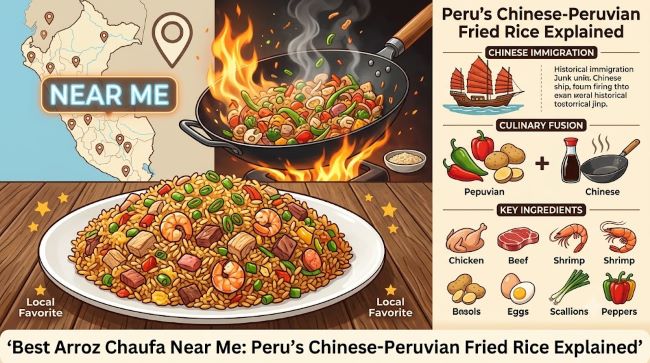
What Arroz Chaufa Is
Chaufa comes from the Cantonese word for fried rice (chao fan). Peruvian Chinese immigration began in earnest in the mid-1800s when Chinese contract laborers arrived to work on Peru’s railroads and guano fields. They brought their cooking traditions with them, adapted them to available local ingredients, and over generations developed what became known as chifa cuisine: the Peruvian-Chinese culinary fusion that today has its own restaurants and is considered a major branch of Peruvian food culture.
Arroz chaufa is chifa’s fried rice: cooked white rice stir-fried in a wok with scrambled egg, green onion, soy sauce, ginger, and sesame oil. The protein varies and is usually chosen by the diner: chicken, beef, pork, shrimp, or a mixed version. Some versions include vegetables like bean sprouts, bell pepper, or baby corn.
What makes arroz chaufa near me different from generic Chinese fried rice is the Peruvian flavor influence: the dish tends to have a slightly more pronounced soy flavor, often uses ají amarillo or other Peruvian chili to add heat and depth, and sometimes incorporates ingredients from Peruvian cooking that wouldn’t appear in a standard Chinese fried rice.
The wok technique is also critical. High heat, fast movement, and short cooking time produce fried rice with individual, slightly charred grains. The wok hei (the smoky, slightly charred quality produced by very high heat) is what gives arroz chaufa its characteristic flavor that you can’t replicate on a standard home stovetop.
Where to Find Arroz Chaufa Near You
Peruvian restaurants. Arroz chaufa is a standard item on nearly every Peruvian restaurant menu. It’s considered as Peruvian as lomo saltado or ceviche. This is your most reliable starting point.
Chifa restaurants. In cities with significant Peruvian communities, dedicated chifa restaurants exist: they specialize in Peruvian-Chinese food and arroz chaufa is the centerpiece of their menu. These spots typically have more variety and depth in their chaufa preparations than a standard Peruvian restaurant.
Latin American restaurants with Peruvian sections. In cities without dedicated Peruvian spots, broader Latin American restaurants sometimes include arroz chaufa on a Peruvian-influenced section of their menu.
US cities with the strongest Peruvian restaurant scenes for finding arroz chaufa near me: Los Angeles (particularly the San Gabriel Valley and Pacoima areas), Miami (Doral and Coral Gables), Paterson and Elizabeth in New Jersey, Houston, and the DC metro area. All have multiple Peruvian restaurants where arroz chaufa is a menu staple.
Search approach: Google Maps filtered for “Peruvian restaurant” in your area. Virtually every Peruvian restaurant carries arroz chaufa. Yelp with “Peruvian” cuisine filter and “chaufa” as a keyword search surfaces reviews that mention the dish specifically.
What a Proper Arroz Chaufa Looks Like
The grain texture. Each grain of rice should be separate and slightly charred in spots from the wok heat. Clumped, sticky rice indicates either too much moisture, insufficient wok heat, or freshly cooked rice used without resting. Day-old rice is the standard for fried rice: it’s drier and separates better in the wok.
The wok hei. The defining quality of well-made arroz chaufa near me is a faint smokiness and char that you can smell as much as taste. It’s produced only by very high heat and a properly seasoned wok. Without it the dish tastes flat, as if something is missing. If the dish smells clean and neutral, the wok heat was insufficient.
The egg. Scrambled egg should be distributed throughout the rice in small broken pieces, not in large chunks or omelette strips. The egg integrates into every bite rather than sitting on top.
The soy color. A properly made arroz chaufa should be uniformly golden-brown from the soy sauce. Pale, white-looking fried rice didn’t get enough soy. Uniformly dark brown fried rice got too much and will taste saltier than it should.
The protein. Whatever protein you choose should be cooked correctly before going into the rice: chicken tender and juicy, shrimp just cooked through, beef slightly pink in the center if you want it at its best. Overcooked protein in fried rice is a common failure mode.
The green onion. Visible slices of green onion throughout, added at the end so they retain their color and a slight bite. Wilted, grey onion went in too early.
The Ají Amarillo Factor
One of the things that can distinguish an exceptional arroz chaufa near me is the presence of ají amarillo. Not every version includes it, but in chifa restaurants and among Peruvian cooks who honor the fusion tradition, a small amount of ají amarillo paste in the wok adds a fruity, moderate heat and a golden color that elevates the dish beyond its Chinese-Peruvian hybrid origins into something uniquely its own.
If you’re at a chifa restaurant and see ají amarillo listed as an ingredient in the arroz chaufa, that’s a signal the kitchen is cooking the dish with full awareness of what makes it distinctly Peruvian.
Arroz Chaufa vs. Lomo Saltado
These two dishes are the twin pillars of chifa cuisine in Peru. Both use wok technique, soy sauce, and Peruvian ingredients. Lomo saltado is a stir-fry of beef strips, tomatoes, and onions served over fries and rice. Arroz chaufa is the rice dish itself. At many Peruvian restaurants, they’re ordered together or alongside each other.
If you haven’t tried both, ordering them on the same visit gives you the clearest picture of what chifa cooking is: two very different results from the same Chinese-Peruvian fusion tradition.
For other Peruvian dishes to build a complete table around your arroz chaufa near me, papa a la huancaína as a starter and arroz chaufa as a main is a natural Peruvian meal structure.
Key Takeaways
- Arroz chaufa is Peruvian-Chinese fried rice from Peru’s chifa cuisine tradition: white rice stir-fried in a wok with egg, green onion, soy sauce, ginger, sesame oil, and a chosen protein, sometimes with ají amarillo for heat and Peruvian character
- It’s a mainstream Peruvian dish appearing on virtually every Peruvian restaurant menu, not an obscure specialty: finding arroz chaufa near me mainly requires finding a Peruvian restaurant
- The wok hei (smoky char from very high heat) is the defining quality of a well-made version: flat, neutral-tasting fried rice lacks this element and indicates insufficient cooking temperature
- Quality markers include separate charred grains, uniform golden-brown color from soy, distributed egg pieces, correct protein texture, and visible green onion
- Day-old rice is the professional standard for fried rice: it’s drier and separates better in the wok than freshly cooked rice
- Dedicated chifa restaurants (Peruvian-Chinese) offer more depth in chaufa preparations than standard Peruvian restaurants and are worth seeking out in cities with large Peruvian communities
- Arroz chaufa and lomo saltado are the twin pillars of chifa cuisine: ordering both on the same visit gives the clearest picture of what the Peruvian-Chinese fusion tradition produces