How Many Jobs Are Available in Capital Goods?
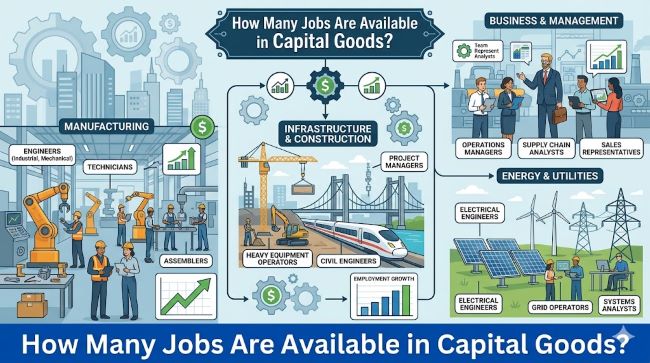
Capital goods is one of the broadest and most economically significant sectors in the US economy, and it’s also one of the least understood in terms of what “capital goods” actually means and what kinds of jobs exist within it. If you’re asking how many jobs are available in capital goods, you’re asking about a category that encompasses manufacturing, heavy equipment, aerospace, defense, industrial machinery, and more — a sector that employs millions of Americans across production, engineering, sales, and operations.
What Capital Goods Are
Capital goods are goods used by businesses to produce other goods or services — as opposed to consumer goods, which are purchased for direct personal use. Examples:
- Industrial machinery (lathes, presses, CNC machines)
- Construction equipment (excavators, cranes, bulldozers)
- Agricultural machinery (tractors, harvesters)
- Aerospace and defense equipment (aircraft, military hardware)
- Medical equipment used in healthcare delivery
- Power generation equipment (turbines, generators)
- Transportation equipment (commercial vehicles, locomotives, ships)
Major capital goods companies include Caterpillar, John Deere, General Electric (industrial divisions), Boeing, Lockheed Martin, Honeywell, Illinois Tool Works, Parker Hannifin, Emerson Electric, and hundreds of mid-sized industrial manufacturers.
How Many Jobs Are Available in Capital Goods
The capital goods sector employs approximately 8-10 million people in the United States across manufacturing, engineering, sales, operations, and support functions. This makes it one of the largest employment sectors in the country by headcount.
At any given point, active job listings in capital goods number in the hundreds of thousands. LinkedIn, Indeed, and sector-specific job platforms typically show 200,000-500,000+ active openings in capital goods-related fields, though this number fluctuates significantly with economic cycles — capital goods spending is highly sensitive to business investment confidence, interest rates, and broader economic conditions.
The Bureau of Labor Statistics (BLS) tracks employment in durable goods manufacturing, which is the closest government category to capital goods: approximately 8 million Americans work in durable goods manufacturing, with millions more in related engineering, sales, and service roles that support the sector.
Types of Jobs in the Capital Goods Sector
The sector is diverse enough that almost any professional background can find a relevant role:
Manufacturing and production:
- Machinist and CNC operator
- Assembly technician
- Welder and fabricator
- Quality control inspector
- Production supervisor and manager
- Manufacturing engineer
Engineering:
- Mechanical engineer
- Electrical engineer
- Industrial engineer
- Design engineer (CAD/CAM)
- Systems engineer
- Aerospace engineer
- Civil/structural engineer (for construction equipment manufacturers)
Sales and business development:
- Capital equipment sales representative
- Technical sales engineer (a specialized role combining engineering knowledge with sales)
- Account manager
- Regional sales manager
- Business development manager
Supply chain and procurement:
- Procurement specialist
- Supply chain manager
- Logistics coordinator
- Inventory analyst
Finance and accounting:
- Financial analyst (industrial sector focus)
- Cost accountant (manufacturing)
- Controller
Software and technology:
- Automation engineer
- Controls engineer (PLC programming)
- Software engineer (embedded systems, industrial software)
- Data analyst (manufacturing analytics)
Field service and technical support:
- Field service engineer or technician
- Service manager
Compensation in Capital Goods
Capital goods jobs span a wide compensation range depending on role type and seniority:
Production and skilled trades: $45,000-$80,000. Machinists, welders, and experienced CNC operators often earn toward the higher end, particularly in specialized or high-precision manufacturing.
Engineering (entry to mid-level): $65,000-$110,000. Mechanical and industrial engineers are heavily recruited in this sector.
Technical sales / sales engineer: $70,000-$150,000+ including commission. Capital equipment sales can be highly lucrative because deal sizes are large.
Senior engineering and management: $100,000-$180,000+.
Executive/C-suite at major capital goods companies: $300,000-$5M+ total compensation at large publicly traded companies.
Economic Cyclicality and Job Availability
One important characteristic of capital goods jobs: the sector is cyclical. When businesses are confident and investing in expansion, capital goods orders surge and hiring accelerates. When the economy contracts or interest rates rise sharply, companies defer capital equipment purchases and hiring slows or contracts.
This means the answer to how many jobs are available in capital goods fluctuates with economic conditions more than in more stable sectors like healthcare or consumer staples. During strong business investment cycles, job postings can be exceptionally high. During downturns, the same sector experiences significant layoffs.
Understanding this cyclicality is important for anyone planning a career in capital goods: building skills that are valuable across the cycle (technical engineering skills, precision manufacturing, specialized sales expertise) provides more stability than roles that are purely volume-dependent.
How to Find Capital Goods Jobs
LinkedIn. Search for specific roles within capital goods companies or search “capital goods” combined with a role title. Following major employers (Caterpillar, Deere, Emerson, Honeywell, Parker Hannifin, GE Aerospace) and setting job alerts is effective.
Indeed and ZipRecruiter. General job search with sector-specific keywords (“industrial manufacturing,” “capital equipment,” “heavy machinery,” specific company names).
Industry associations. The Association for Manufacturing Technology (AMT), the Aerospace Industries Association (AIA), and the National Association of Manufacturers (NAM) maintain career resources and job boards.
Company careers pages directly. Major capital goods companies have large talent pipelines and post extensively on their own careers sites before or alongside job boards.
Breaking Into Capital Goods: Education and Entry Paths
Engineering degrees (mechanical, electrical, industrial, aerospace) are the most direct pathway into technical capital goods roles. Major capital goods companies recruit heavily from engineering programs at state universities and technical schools, particularly those near manufacturing centers in the Midwest, Southeast, and Southwest.
For sales and business development roles, business degrees combined with technical aptitude or a technical background are common. Technical sales is one of the higher-compensation roles in capital goods and is typically accessible with either an engineering degree plus sales training or a business degree plus strong technical self-study.
For production roles, technical certificates, associate degrees in manufacturing technology, and apprenticeship programs through manufacturers or trade associations (NIMS — the National Institute for Metalworking Skills — certifies machinists) provide direct entry.
The capital goods sector is also a significant destination for veterans transitioning from military service: military technical training in maintenance, logistics, and operations translates directly to civilian capital goods roles, and many major manufacturers have dedicated veteran hiring programs.
How many jobs are available in capital goods correlates with economic cycles, but the underlying technical skills remain in demand across cycles: precision manufacturing, engineering design, and industrial sales expertise don’t become obsolete during downturns.
Key Takeaways
- How many jobs are available in capital goods: approximately 8-10 million Americans work in the capital goods sector broadly defined, with hundreds of thousands of active job listings at any time on major platforms
- Capital goods includes industrial machinery, construction equipment, aerospace and defense, agricultural equipment, and power generation — any goods used by businesses to produce other goods
- Job types span production and skilled trades, engineering (mechanical, electrical, industrial), technical sales, supply chain, finance, software, and field service
- Compensation ranges from $45,000 for entry production roles to $150,000+ for technical sales and senior engineering, with executive compensation significantly higher
- The sector is economically cyclical: job availability fluctuates with business investment confidence and interest rate cycles more than in consumer-facing sectors
- Major employers include Caterpillar, John Deere, Boeing, Honeywell, Parker Hannifin, Emerson Electric, GE Aerospace, Illinois Tool Works, and hundreds of mid-size industrial manufacturers