How Many Tablespoons in 1/4 Cup: Complete Cooking Measurement Guide
You’re in the middle of cooking and realize you don’t have the right measuring cup. Your recipe calls for 1/4 cup of an ingredient, but you only have tablespoons available. So you need to know: how many tablespoons in 1/4 cup?
The answer is simple: there are 4 tablespoons in 1/4 cup. This single conversion unlocks your ability to measure accurately even when your measuring cup collection doesn’t match your recipe’s needs. Understanding this relationship, plus a few other key conversions, makes cooking and baking easier and more reliable.
The Basic Conversion: 1/4 Cup Equals 4 Tablespoons
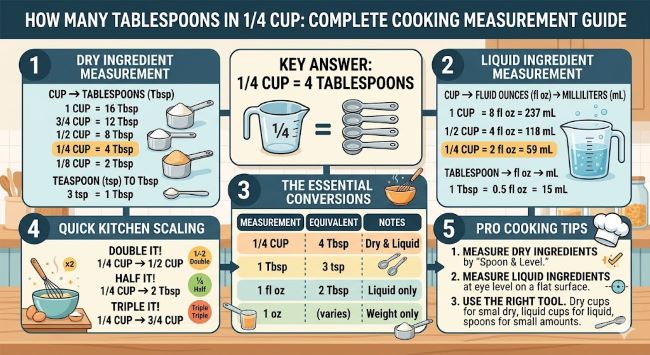
Let’s start with the foundational fact. How many tablespoons in 1/4 cup? The answer is 4 tablespoons. This straightforward conversion forms the basis for understanding other cup-to-tablespoon measurements.
This works because 1 cup equals 16 tablespoons. When you divide 16 by 4, you get 4. Therefore, 1/4 cup equals 4 tablespoons.
This conversion stays consistent. Every time you need to convert 1/4 cup to tablespoons, the answer is always 4 tablespoons. You can rely on this.
Understanding the Full Cup Conversion
To grasp why how many tablespoons in 1/4 cup equals 4, understanding the complete picture helps. How many tablespoons in a cup is the foundational measurement.
1 cup equals 16 tablespoons. This is the standard measurement in American cooking and baking. Once you remember this, all other conversions become math problems.
If 1 cup equals 16 tablespoons, then:
- 1/4 cup equals 4 tablespoons
- 1/3 cup equals about 5.3 tablespoons (often rounded to 5 tablespoons)
- 1/2 cup equals 8 tablespoons
- 3/4 cup equals 12 tablespoons
These conversions flow directly from the base fact that one cup contains 16 tablespoons.
Other Common Cup Conversions
Recipes use various cup measurements, and knowing the tablespoon equivalents helps when you need substitutions.
1/8 Cup to Tablespoons: 1/8 cup equals 2 tablespoons. This measurement appears less frequently but shows up in some recipes.
1/3 Cup to Tablespoons: 1/3 cup equals about 5.3 tablespoons, which cooks often round to 5 tablespoons for simplicity.
1/2 Cup to Tablespoons: How many tablespoons in 1/2 cup? The answer is 8 tablespoons. This common measurement appears frequently in recipes.
3/4 Cup to Tablespoons: How many tablespoons in 3/4 cup? The answer is 12 tablespoons. This three-quarter measurement shows up often in recipes.
Knowing these conversions means you can measure any cup amount using tablespoons if you need to.
Converting Tablespoons Back to Cups
Sometimes recipes give measurements in tablespoons and you want to know the cup equivalent. These reverse conversions work just as well.
4 Tablespoons to Cups: 4 tablespoons equals 1/4 cup. This mirrors the forward conversion.
8 Tablespoons to Cups: 8 tablespoons equals 1/2 cup.
12 Tablespoons to Cups: 12 tablespoons equals 3/4 cup.
16 Tablespoons to Cups: 16 tablespoons equals 1 cup.
6 Tablespoons to Cups: 6 tablespoons equals 3/8 cup (or a bit more than 1/3 cup).
3 Tablespoons to Cups: 3 tablespoons equals just under 1/4 cup. This small amount sometimes shows up in recipes.
These conversions work the same direction as the cup-to-tablespoon conversions.
When You Need This Conversion
Understanding how many tbsp in 1/4 cup becomes essential in several cooking situations.
You’re following a recipe that calls for 1/4 cup of an ingredient. Your measuring cups are dirty, lost, or misplaced. You only have tablespoons available. Converting 1/4 cup to 4 tablespoons solves the problem.
Your measuring equipment doesn’t match the recipe’s measurements. Some people prefer measuring spoons, others prefer cups. Converting between them lets everyone measure accurately with their preferred tools.
You’re scaling a recipe up or down. Converting to tablespoons makes fractional adjustments easier. Instead of trying to measure 1/8 cup, you measure 2 tablespoons, which feels more natural.
You need to measure very small amounts. One tablespoon breaks down into 3 teaspoons. This precision helps in baking where exact measurements matter.
Dry Ingredients Versus Liquid Ingredients
One important note: these conversions work for both dry and liquid ingredients in terms of volume. However, weight differs between ingredients.
Tbsp to cup conversions measure volume, not weight. 1/4 cup of butter weighs different from 1/4 cup of flour even though they occupy the same space.
For most cooking purposes, volume conversions work fine. You measure flour by volume. You measure milk by volume. The conversion between tablespoons and cups works regardless of what you’re measuring.
However, for precise baking, weight measurements matter more than volume. Professional bakers weigh ingredients rather than measuring by cups or tablespoons. But for home cooking and most recipes, volume conversions serve perfectly well.
Using Conversion Charts
Many cooks keep conversion charts handy. A simple reference showing tablespoons in a cup and other conversions prevents the need to calculate each time.
A basic chart covers:
- 1 tablespoon equals 3 teaspoons
- 1/4 cup equals 4 tablespoons
- 1/3 cup equals 5 tablespoons plus 1 teaspoon
- 1/2 cup equals 8 tablespoons
- 3/4 cup equals 12 tablespoons
- 1 cup equals 16 tablespoons
Some cooks print these and tape them inside a kitchen cabinet. Others bookmark conversion websites on their phones. Having this information readily available speeds up cooking.
Measuring Techniques for Accuracy
Whether you use cups or tablespoons, measuring accurately matters for consistent results.
For Dry Ingredients: Spoon the ingredient into your measuring vessel. Don’t scoop directly from the container, which compresses the ingredient and gives you more than you need. Fill to the top and level off with a knife.
For Wet Ingredients: Use a transparent measuring cup. Pour the ingredient until it reaches the desired mark. Check at eye level for accuracy. Meniscus, the curve at the top of liquid, should align with your measurement mark.
For Tablespoons: Fill to the top and level off with a knife, just like dry ingredients. If the ingredient is sticky, use a slightly overfull tablespoon unless the recipe specifies otherwise.
Accurate measuring leads to better results. Whether you measure in cups or convert to tablespoons, these techniques ensure you’re measuring the same amount each time you make a recipe.
Common Questions About Cup and Tablespoon Conversions
How Many Teaspoons in a Cup? One cup equals 48 teaspoons. This conversion helps when recipes call for very small amounts.
Does This Work in Other Countries? These measurements apply to US cooking. Other countries use different systems. The metric system uses milliliters. British cooking uses slightly different cup sizes. Always verify which measurement system your recipe uses.
What If My Recipe Is Vague? Some older recipes don’t specify cup or tablespoon amounts clearly. Context helps. If a recipe says “add flour” without measurement, you’re adding until the consistency feels right. This requires experience and judgment beyond simple conversions.
Can I Use These Conversions for All Ingredients? Yes, for volume measurements. The conversion between tablespoons and cups measures volume, not weight. This works for all ingredients.
Practical Examples
Let’s walk through some real cooking scenarios using these conversions.
Scenario One: A recipe calls for 1/4 cup of olive oil. You only have tablespoons. You measure 4 tablespoons of olive oil into your pan.
Scenario Two: A recipe calls for 1/3 cup of sugar. You don’t have a 1/3 cup measure. You measure 5 tablespoons of sugar plus 1 teaspoon into your mixing bowl.
Scenario Three: A recipe calls for 6 tablespoons of butter. You have a 1/4 cup measure. You know 1/4 cup equals 4 tablespoons, so you measure 1/4 cup plus 2 additional tablespoons.
Scenario Four: You’re halving a recipe that calls for 1/2 cup of milk. You need 1/4 cup of milk. You measure 4 tablespoons instead.
These scenarios show how knowing conversions solves real cooking problems.
Kitchen Tools for Measuring
Different measuring tools help in different situations.
Measuring Cup Set: A complete set includes 1 cup, 1/2 cup, 1/3 cup, and 1/4 cup measures. These handle most recipes.
Measuring Spoon Set: A complete set includes 1 tablespoon, 1 teaspoon, 1/2 teaspoon, and 1/4 teaspoon. These handle smaller measurements and conversions.
Digital Scale: For precise baking, a scale weighs ingredients. This eliminates questions about conversions and packing.
Liquid Measuring Cup: Specifically designed for liquids with a spout for pouring. Handles volume measurement accurately.
Dry Ingredient Measuring Cup: Designed for dry goods with a flat top for leveling off.
Having multiple tools removes the need for conversions. However, knowing conversions helps when the right tool isn’t available.
Making Conversions Stick
Want to remember these conversions easily? A few memory tricks help.
Remember that 1 cup equals 16 tablespoons. Think of it as 1 cup having four quarters. 16 divided by 4 equals 4 tablespoons per quarter cup. This logic works for all the conversions.
How many tbsp in a cup? Sixteen.
How many tbsp in 1/4 cup? Four.
How many tbsp in 1/2 cup? Eight.
How many tbsp in 3/4 cup? Twelve.
Once you remember that 1 cup equals 16 tablespoons, you can calculate any conversion.
Key Takeaways
- How many tablespoons in 1/4 cup? The answer is 4 tablespoons, a fundamental cooking measurement.
- How many tablespoons in a cup? The base fact is 16 tablespoons equals 1 cup.
- 1/4 cup to tbsp conversions work the same as any cup-to-tablespoon conversion.
- How many tbsp in 1/2 cup? The answer is 8 tablespoons, half of the full cup measurement.
- How many tablespoons in 1/3 cup? The answer is about 5.3 tablespoons, often rounded to 5 tablespoons.
- How many tablespoons in 3/4 cup? The answer is 12 tablespoons.
- Tablespoons to cups conversions work in reverse with the same math.
- Tbsp to cup conversions measure volume and work for all ingredients.
- Accurate measuring, whether in cups or tablespoons, produces consistent cooking and baking results.
- Having conversion charts or quick references available in the kitchen speeds up cooking.
- Understanding that 1 cup equals 16 tablespoons unlocks all other conversions.
- Different cooking situations call for different measurement tools, but conversions help when the right tool isn’t available.
- These US measurement conversions don’t apply to metric or other cooking systems.
- Memorizing key conversions like 1/4 cup equals 4 tablespoons removes the need for calculation.
- Whether you use cups, tablespoons, or teaspoons, measuring consistently matters more than which tool you choose.